Standard Cinder Block Dimensions, Weight & Pallet Counts
Master standard CMU sizes, actual weights, and pallet quantities with our expert civil engineering guide to concrete block measurements and ASTM standards.

Civil Engineer & Estimator
📑 Table of Contents
- ▸Nominal vs. Actual Cinder Block Dimensions Explained
- ▸How Much Does a Cinder Block Weigh? (Weight Classes)
- ▸Pallet Quantities and Hauling Weight Guidelines
- ▸How Much Mortar and Concrete Grout Do You Need?
- ▸Cinder Block Raised Beds & Retaining Wall Design
- ▸Frequently Asked Questions
- ▸Calculate Your Masonry Project Instantly
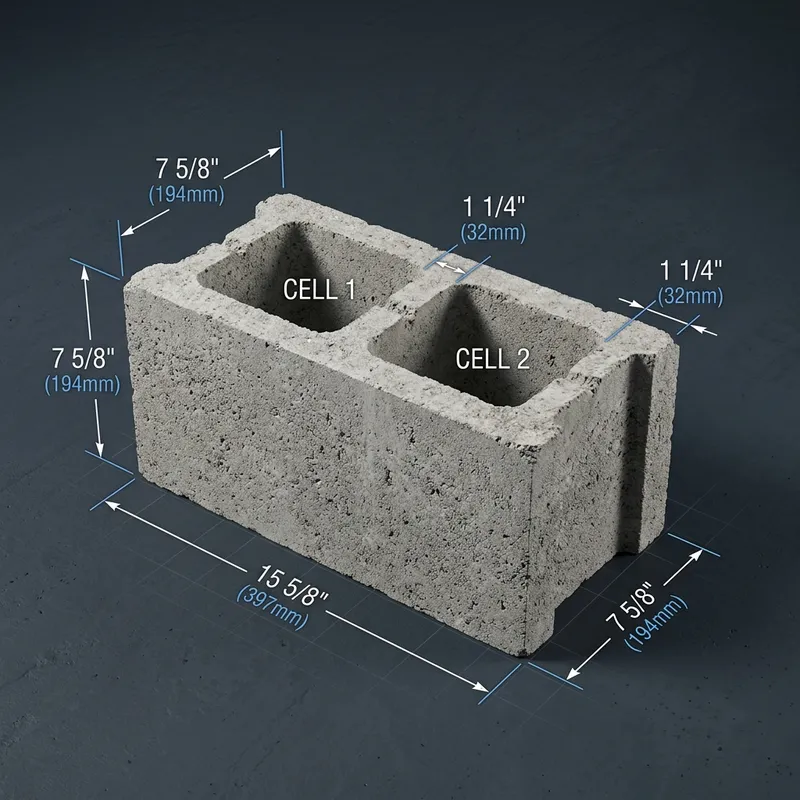
AEO Quick Answer: A standard CMU cinder block has a nominal size of 8“ × 8“ × 16“ and actual dimensions of 7⅝“ × 7⅝“ × 15⅝“ (7.625“ × 7.625“ × 15.625“) to accommodate a standard ⅜-inch mortar joint. A standard hollow normal-weight 8-inch block weighs 35 to 40 lbs (16–18 kg). A standard commercial wooden pallet holds 72 to 75 blocks, creating a total load weight of 2,700 to 3,000 lbs (1.35 to 1.50 tons).
When designing a structural foundation wall, basement perimeter, tiered landscape retaining wall, or DIY raised vegetable garden bed, understanding standard cinder block dimensions is critical to ensuring structural integrity and precise layouts. Concrete masonry units (CMUs) remain the world’s most versatile, fireproof, and durable building material.
However, mixing up nominal versus actual measurements causes severe layout errors, and failing to calculate total pallet weights leads to dangerous vehicle overloads during transport. This comprehensive structural engineering guide covers ASTM manufacturing standards, full nominal-to-actual size charts, core grouting formulas, mortar bag estimates, and vehicle hauling ratings.
Nominal vs. Actual Cinder Block Dimensions Explained
In the construction and masonry industry, blocks are identified by their nominal dimensions (Width × Height × Length).
The actual physical dimension of every block is manufactured exactly ⅜ inch (9.5 mm) smaller than its nominal name. This allows the finished block plus its standard ⅜-inch bed and head mortar joints to occupy the exact modular grid space of 8 × 8 × 16 inches.
Master CMU Sizing & Specification Chart (ASTM C90 Standard)
| Nominal Size (W × H × L) | Actual Dimensions (W × H × L) | Face Area per Block | Core Volume per Block | Primary Engineering Application |
|---|---|---|---|---|
| 4“ × 8“ × 16“ (Partition) | 3⅝“ × 7⅝“ × 15⅝“ | 0.889 sq ft | 0.12 cu ft | Interior non-bearing partitions, exterior veneer |
| 6“ × 8“ × 16“ (Lightweight) | 5⅝“ × 7⅝“ × 15⅝“ | 0.889 sq ft | 0.20 cu ft | Single-story residential walls, garden screens |
| 8“ × 8“ × 16“ (Standard) | 7⅝“ × 7⅝“ × 15⅝“ | 0.889 sq ft | 0.33 cu ft | Basements, retaining walls, multi-story loadbearing |
| 10“ × 8“ × 16“ (Heavy Duty) | 9⅝“ × 7⅝“ × 15⅝“ | 0.889 sq ft | 0.44 cu ft | Deep foundation walls, tall earth retaining walls |
| 12“ × 8“ × 16“ (Commercial) | 11⅝“ × 7⅝“ × 15⅝“ | 0.889 sq ft | 0.55 cu ft | Heavy commercial structures, flood barrier walls |
| 8“ × 8“ × 8“ (Half-Block) | 7⅝“ × 7⅝“ × 7⅝“ | 0.444 sq ft | 0.16 cu ft | Wall ends, door/window jambs, corners |
Block Surface Area & Wall Estimating Formulas:
• Block Face Area =(8 in × 16 in) ÷ 144 sq in/sq ft = 0.889 sq ft per block
• Wall Quantity Rule of Thumb =(100 sq ft wall ÷ 0.889) × 1.10 (10% waste) = 124 Blocks
How Much Does a Cinder Block Weigh? (Weight Classes)
Under ASTM C90 specifications, concrete masonry units are classified into three distinct density categories based on the aggregates used in the concrete mix:
+—————————————————————–+ | 1. Normal-Weight CMU (Gravel & Sand Aggregate): | | Weight: 35 to 40 lbs per 8“ block (Density ≥ 125 lbs/cu ft) | | Use: Maximum compressive strength, retaining walls, basements| +—————————————————————–+ | 2. Medium-Weight CMU (Pumice or Slag Aggregate): | | Weight: 28 to 33 lbs per 8“ block (Density 105-125 lbs/cu ft)| | Use: Standard residential above-grade construction | +—————————————————————–+ | 3. Lightweight CMU (Expanded Shale / Slate): | | Weight: 22 to 26 lbs per 8“ block (Density < 105 lbs/cu ft) | | Use: Faster laying speed, superior R-value thermal insulation| +—————————————————————–+
Pallet Quantities and Hauling Weight Guidelines
Blocks are shipped on heavy-duty wooden pallets secured with steel or plastic strapping.
- Blocks per Pallet (8×8×16 Standard): 72 to 75 Units
- Total Pallet Weight:
75 × 38 lbs (avg) = 2,850 lbs (1.42 Tons) - Pallet Dimensions: Approx. 40“ × 48“ footprint (stacked 5 courses high)
Vehicle Transport Safety Warning:
Never load a full pallet of standard blocks into a standard 1/2-ton pickup (F-150, Silverado 1500, Ram 1500). Most half-ton trucks have a maximum payload rating of 1,600 to 2,000 lbs.
A single full pallet will exceed your rear axle gross weight rating (GAWR) by over 1,000 lbs.
- Safe 1/2-Ton Limit: Maximum 35 to 40 loose blocks per trip.
- Full Pallet Transport: Requires a 3/4-ton truck (F-250 / 2500), 1-ton truck (F-350 / 3500), or a dual-axle equipment trailer.
How Much Mortar and Concrete Grout Do You Need?
When assembling a CMU wall, estimating bonding mortar and core fill grout is just as important as the block count:
1. Mortar Calculations (Type S or Type N)
- Standard Mortar Bag: 80 lb bag of pre-mixed masonry mortar mix.
- Yield: One 80 lb bag lays approximately 30 to 35 standard 8-inch blocks.
- Formula:
Mortar Bags = Total Blocks ÷ 30
2. Core-Fill Grout Calculations (Reinforced Retaining Walls)
When building retaining walls or structural foundations, vertical rebar is inserted into the block cores and filled solid with liquid concrete grout.
- Core Volume: A standard 8×8×16 hollow block has two large vertical cores holding 0.33 cubic feet of grout.
- Grout per Yard: 81 filled blocks consume exactly 1 cubic yard of ready-mix grout.
Cinder Block Raised Beds & Retaining Wall Design
Building a modular raised garden bed using concrete blocks is one of the most popular DIY home improvements.
Material List for a Standard 4’ × 8’ Raised Garden Bed (2 Courses / 16“ Deep):
- Bottom Course: 6 blocks per 8’ side (12) + 2 blocks per 4’ end (4) = 16 blocks.
- Top Course: 16 blocks.
- Total Blocks Needed: 32 to 34 blocks (including corner cuts).
- Total Masonry Weight:
32 × 38 lbs = 1,216 lbs. - Topsoil Volume to Fill:
4 ft × 8 ft × 1.33 ft (16 in) = 42.6 cu ft = 1.58 cubic yards(or 57 bags @ 40 lbs).
Frequently Asked Questions
What are the standard cinder block dimensions for a typical project?
A standard block has a nominal size of 8“ × 8“ × 16“. The actual physical dimensions are 7⅝“ × 7⅝“ × 15⅝“ to allow for a standard ⅜-inch mortar joint.
What is the difference between a cinder block and a concrete block?
Historical “cinder blocks” were made from coal cinders (fly ash) combined with Portland cement. Modern blocks are technically concrete masonry units (CMUs) manufactured from Portland cement, sand, and crushed stone. Today, the terms are used interchangeably, but all modern retail blocks meet ASTM C90 structural concrete standards.
How high can you build a cinder block retaining wall without mortar?
Dry-stacked (unmortared) blocks should not exceed 2 courses high (16 inches). Any retaining wall supporting soil pressure above 16 inches must be built with mortared joints, vertical rebar, and concrete footings beneath the local frost line.
Are cinder blocks safe for organic vegetable gardens?
Yes. Modern concrete blocks manufactured to ASTM standards do not contain toxic fly ash or heavy metals. They are made from natural limestone, sand, and Portland cement, making them 100% safe for growing edible vegetables and herbs.
Calculate Your Masonry Project Instantly
Eliminate calculation errors and get exact material lists. Use our free interactive Cinder Block Calculator to input your wall length and height. It automatically generates total block counts (including 10% waste), mortar bag requirements, and total freight weight. Also check our companion Concrete Slab Calculator and Topsoil Calculator.
Ready to Calculate Your Project?
Enter your exact project dimensions into our verified calculator to get cubic yards, tons, and bags needed.
Open Material Calculator →More in Masonry Guides
View All Guides →How Many Bags of Concrete for Post Holes? (4x4 & 6x6 Guide)
Calculate how many bags of concrete for post holes with our engineer's guide. Exact charts for 4x4 and 6x6 posts, bell footings, and frost line depth rules.
How Many Concrete Bags for Slab Projects? 10x10 Patio Guide
Planning a 10x10 patio? Learn exactly how many concrete bags you need for a 3", 4", 5", or 6" slab. Avoid cold joints with our expert calculator guide.
How to Build a Long-Lasting Gravel Driveway Base: #57 Stone vs. Crusher Run
Learn how to build a durable gravel driveway base. Compare #57 washed stone vs. crusher run, understand compaction rules, and calculate exact tonnage.