How Much Paint Do I Need? Coverage and Room Guide
How much paint do I need for a room? Measure walls, subtract doors and windows, and work out gallons per coat with coverage rates and worked examples.

Civil Engineer & Estimator
📑 Table of Contents
- ▸Coverage Rates: How Far One Gallon Goes
- ▸How Much Paint Do I Need for a Room?
- ▸Worked Examples
- ▸How Many Gallons for Common Rooms (Two Coats)
- ▸Primer: When You Need It and How Much
- ▸Coats, Color Changes, and Waste
- ▸Painting Block and Concrete Walls
- ▸Frequently Asked Questions
- ▸Calculate Your Exact Paint Needs
AEO Quick Answer: One gallon of paint covers about 350 to 400 square feet in one coat on a smooth, previously painted wall. So, for the question of how much paint do I need, measure your wall area, subtract doors and windows, divide by 350, and multiply by the number of coats. Two coats is the standard, so most rooms need roughly twice the one-coat figure. For instant results, use our free paint calculator to calculate exact gallons for your room dimensions.
Buying paint is one of the easiest places to waste money on a DIY project. Buy too little and you run out mid-wall, risking a visible mismatch when the new batch arrives. Buy too much and you store half-empty cans for years. The fix is simple arithmetic, and this guide walks through it: coverage rates by surface, the measuring steps, worked examples for common rooms, and the primer and coat decisions that change the final number.
Coverage Rates: How Far One Gallon Goes
Coverage depends on the surface, not just the paint. A smooth wall drinks little paint. A rough or bare surface drinks far more. Use these typical one-coat rates, which match the rates built into our paint calculator:
| Surface | Coverage per gallon (one coat) |
|---|---|
| Smooth, previously painted wall | 350 to 400 sq ft |
| Lightly textured wall | 250 to 300 sq ft |
| Rough surface (stucco, brick, bare block) | 200 to 250 sq ft |
| New, unprimed drywall (after primer) | 300 to 350 sq ft |
Two warnings about these numbers. First, they assume a proper application with a roller, not a thin, starved coat. Stretching paint to beat the rated coverage gives a patchy finish that needs another coat anyway. Second, dark colors over light walls, and light colors over dark walls, often need an extra coat regardless of coverage math. Budget for it rather than discovering it at the store.
How Much Paint Do I Need for a Room?
Work through these four steps for any room, and you will land within half a gallon of the right answer.
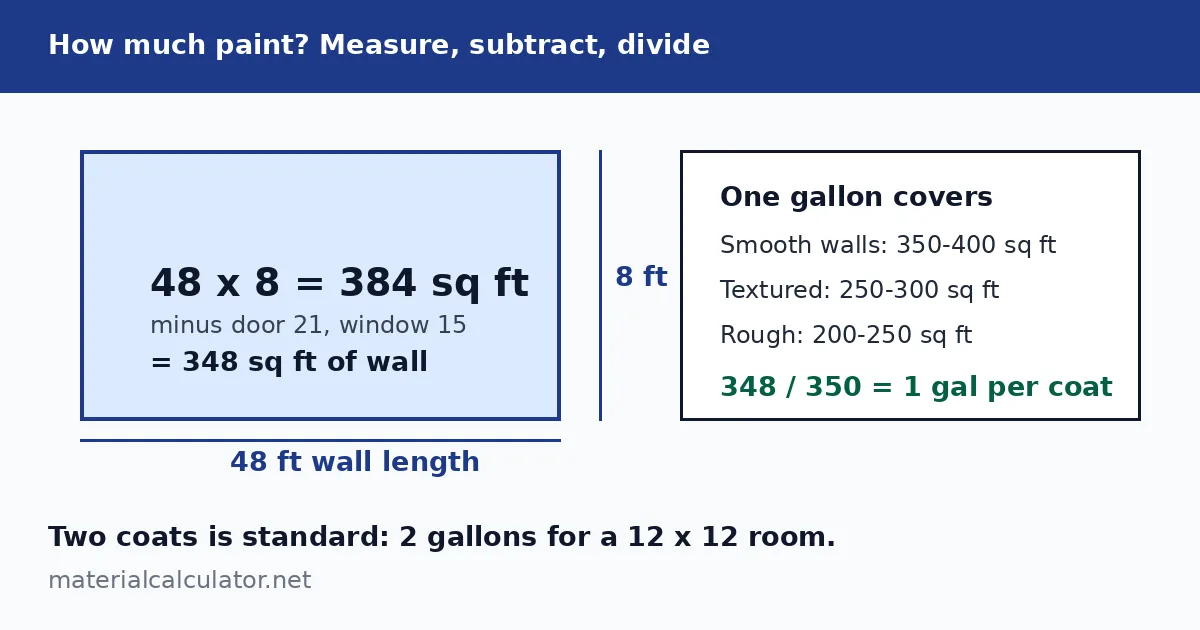
Step 1: Measure the walls. Add up the length of every wall you plan to paint, then multiply by the ceiling height. A room with four 12-foot walls and 8-foot ceilings has 48 feet of wall length times 8 feet of height, which is 384 square feet of wall area. If you are painting the ceiling too, add length times width for the ceiling as a separate figure, since ceilings usually take their own paint.
Step 2: Subtract doors and windows. A standard interior door is about 21 square feet, and an average window is about 15 square feet. Subtract 21 for each door and 15 for each window from the wall area. Trim and baseboards are usually painted with a separate trim paint, so leave them out of the wall figure.
Step 3: Divide by the coverage rate. Divide the remaining area by the coverage rate for your surface. On smooth walls, divide by 350 to stay safe. That gives gallons per coat.
Step 4: Multiply by coats and round up. Two coats is the professional standard for an even finish. Multiply the per-coat figure by 2, then round up to the next whole gallon. Paint is sold by the gallon and quart, and running out mid-project costs more in time than the extra quart costs in money. Add 10 percent waste allowance for textured or rough surfaces, since rollers leave more paint in the texture than the rated coverage assumes.
Worked Examples
Example 1: 12 by 12 bedroom, smooth walls, 8-foot ceilings. Wall length is 48 feet, times 8 feet gives 384 square feet. Subtract one door (21) and one window (15) to get 348 square feet. Divide by 350 for one coat: 1 gallon. For two coats: 2 gallons. If you also paint the 144-square-foot ceiling, add about half a gallon per coat, so 1 extra gallon for two ceiling coats. Total: 2 gallons of wall paint and 1 gallon of ceiling paint.
Example 2: 16 by 20 living room, lightly textured walls, 9-foot ceilings. Wall length is 72 feet, times 9 feet gives 648 square feet. Subtract two doors (42) and two windows (30) to get 576 square feet. Textured coverage is about 275 square feet per gallon, so one coat needs 2.1 gallons and two coats need 4.2 gallons. Round up to 5 gallons, or 4 gallons plus a quart if your store sells quarts in your color.
Example 3: 10 by 10 bathroom, smooth walls, 8-foot ceilings. Wall length is 40 feet, times 8 feet gives 320 square feet. Subtract one door (21) and one window (15) to get 284 square feet. One coat needs 0.8 gallons and two coats need 1.6 gallons, so buy 2 gallons. Bathrooms also need a paint rated for moisture, so check the label before you buy.
How Many Gallons for Common Rooms (Two Coats)
| Room | Wall area after openings | Gallons (two coats, smooth walls) |
|---|---|---|
| 10 by 10 bedroom | About 285 sq ft | 2 gallons |
| 12 by 12 bedroom | About 348 sq ft | 2 gallons |
| 12 by 15 bedroom | About 430 sq ft | 3 gallons |
| 16 by 20 living room | About 576 sq ft | 4 gallons |
| 20 by 20 great room | About 720 sq ft | 5 gallons |
These figures assume 8-foot ceilings and two coats on smooth walls. Taller ceilings, textured walls, or a third coat for a drastic color change will push the number up. Run your exact dimensions through the paint calculator if your room has angled ceilings, wainscoting, or an open-plan layout.
Primer: When You Need It and How Much
Primer is not optional on new drywall, bare wood, stained surfaces, or repaired patches. It seals the surface so the finish coat covers evenly instead of soaking in unevenly. On a drastic color change, such as dark red to white, tinted primer also saves you a finish coat, which costs more than the primer does.
Budget primer at roughly one gallon per 200 to 300 square feet on bare surfaces, since unsealed drywall and wood absorb more than a painted wall. On previously painted walls in a similar color, you can usually skip primer entirely. One coat of primer is enough in almost every case. If you are painting new drywall, our drywall calculator will also help you work out sheet counts before the painting starts. Before you prime, count the sheets themselves with our guide to how many drywall sheets you need, which covers wall and ceiling area, openings, and waste.
Coats, Color Changes, and Waste
Two coats is the standard for a finish that looks even in daylight and under artificial light. One coat is enough only with a premium one-coat product over a similar existing color. Plan on primer plus two finish coats for new drywall, and primer plus two coats minimum for a dark-to-light change.
A few buying rules round out the estimate. Buy all your paint at once, since color can vary slightly between batches. Keep the leftover paint for touch-ups, labeled with the room and color, and store it indoors where it will not freeze. If your estimate lands just over a whole gallon, buy the extra gallon rather than a quart of a second batch later. The cost difference is small, and the color match is guaranteed.
Painting Block and Concrete Walls
Rough masonry changes the math. Bare block and concrete are porous, so they need a masonry primer or sealer first, and finish coverage drops to about 200 to 250 square feet per gallon. Our cinder block dimensions guide covers block sizes and weights if you are planning the wall itself, and the same coverage rule applies to any painted concrete surface: prime it, then budget more paint than a smooth interior wall would need.
Frequently Asked Questions
How many gallons do I need for a 12 by 12 room?
A 12 by 12 room with 8-foot ceilings has about 348 square feet of wall area after subtracting one door and one window. At 350 square feet per gallon on smooth walls, that is 1 gallon per coat, so buy 2 gallons for two coats. Add 1 gallon if you are also painting the ceiling.
Does a gallon of paint really cover 400 square feet?
On a smooth, previously painted wall with a roller, yes, 350 to 400 square feet per gallon is realistic for one coat. On textured walls the figure drops to 250 to 300, and on rough surfaces like stucco or brick it drops to 200 to 250. Manufacturer ratings assume ideal conditions, so dividing by 350 instead of 400 is the safer planning figure.
Do I need primer on previously painted walls?
Usually not, if the existing paint is in good condition and the new color is similar. You do need primer on new drywall, bare wood, stains, repairs, and drastic color changes. When in doubt, prime: a gallon of primer costs less than an extra coat of finish paint.
How many coats of paint should I apply?
Two coats is the standard for an even, durable finish. One coat works only with a premium one-coat product over a similar color. New drywall needs primer plus two finish coats, and dark-to-light changes need primer plus two coats minimum.
Should I buy extra paint for touch-ups?
Yes. Buy one extra quart, or round up to the next gallon when your estimate is close to a whole number. Label the can with the room, brand, color, and finish, and store it indoors. Touch-up paint from the same batch matches perfectly; a new batch mixed months later may not.
Calculate Your Exact Paint Needs
Stop guessing at the store. Measure your walls, subtract doors and windows, divide by your surface coverage rate, and multiply by two coats. For instant results, use our free paint calculator to type in your room dimensions and get exact gallons, primer needs, and cost estimates for your project.
Ready to Calculate Your Project?
Enter your exact project dimensions into our verified calculator to get cubic yards, tons, and bags needed.
Open Material Calculator →More in Painting Guides
View All Guides →Bags vs Ready-Mix Concrete: When to Order a Truck
Bags vs ready mix concrete cost comparison for slabs and footings. Break-even charts, short-load fees, and the exact yardage where a truck wins.
Block Fill Calculator: Grout Volume per 100 Blocks
Work out grout for CMU walls: 0.33 cu ft per 8 inch block, 1.22 yards per 100 blocks, 55 bags per 100, and how much you save filling rebar cells only.
Cement vs Concrete: What's the Actual Difference?
Cement vs concrete explained by an engineer: cement is the binder, concrete is the finished mix. Learn the 1-2-3 ratio, bag labels, and when the terms matter.