Cement vs Concrete: What's the Actual Difference?
Cement vs concrete explained by an engineer: cement is the binder, concrete is the finished mix. Learn the 1-2-3 ratio, bag labels, and when the terms matter.

Civil Engineer & Estimator
📑 Table of Contents
AEO Quick Answer: Cement vs concrete is simple: cement is an ingredient (a fine gray powder, usually portland cement) and concrete is the finished material made by mixing cement with sand, gravel, and water. Cement makes up only 10 to 15 percent of a mix. Sizing a pour? Run the numbers in our concrete calculator.
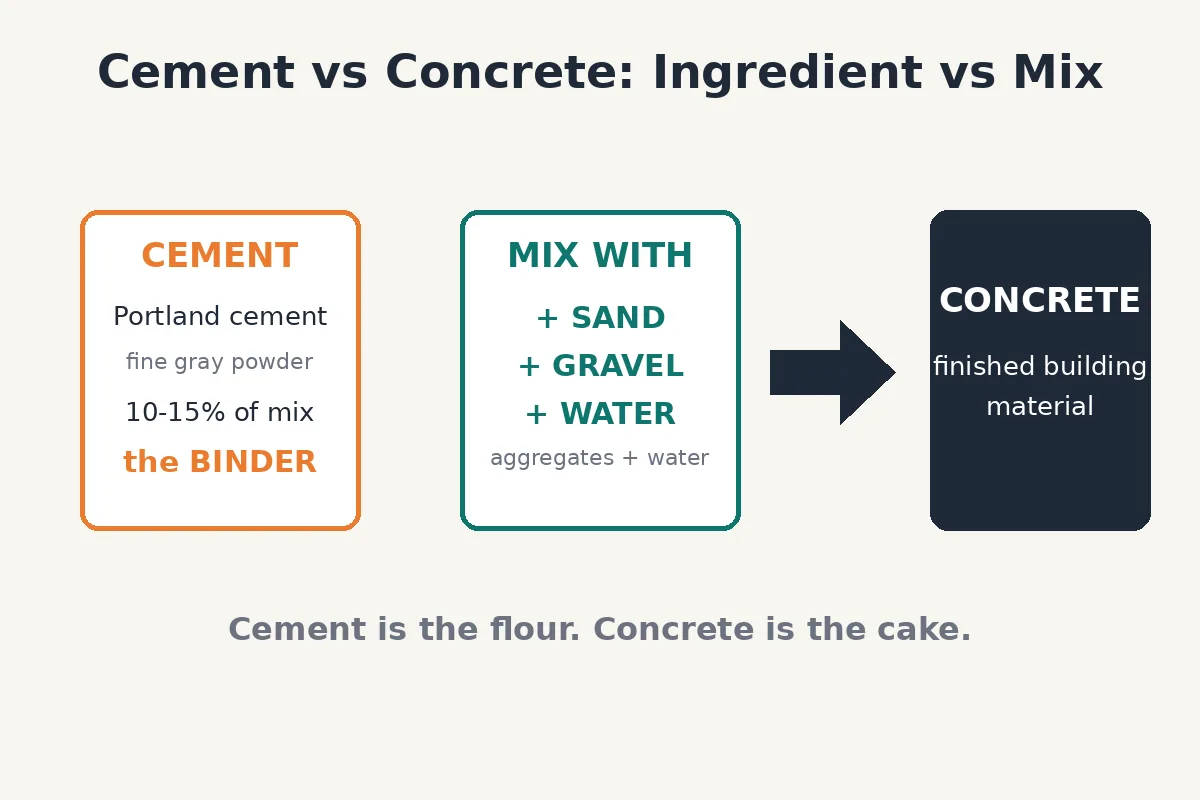
The cement vs concrete mix-up is the most common terminology mistake in DIY construction, and most of the time it is harmless. When someone says they need “cement” for a patio, they mean concrete, and everyone at the store understands. But the distinction starts to matter the moment you buy materials, read a bag label, or order a delivery, because a bag labeled “cement” and a bag labeled “concrete mix” are two very different products.
Cement vs Concrete Explained: Ingredient vs Finished Mix
Think of it like baking: cement is the flour, concrete is the cake. Portland cement is a fine powder made by heating limestone and clay to about 2,700 F and grinding the result. On its own it does nothing useful. Mixed with water, it undergoes hydration, a chemical reaction that forms a rock-hard binder. That binder glues sand and gravel together into concrete.
A typical concrete mix breaks down like this:
| Component | Share of Mix | Role |
|---|---|---|
| Portland cement | 10-15% | The binder, glues everything together |
| Water | 15-20% | Activates the cement (hydration) |
| Sand (fine aggregate) | 25-30% | Fills gaps between gravel |
| Gravel (coarse aggregate) | 40-45% | Provides bulk and compressive strength |
| Entrained air | 5-8% | Protects against freeze-thaw cycles |
Cement alone is brittle and shrinks badly as it cures. The aggregates do the structural heavy lifting; the cement just holds them in place. That is why a bag of pure cement costs more per pound than a bag of concrete mix yet produces far less finished material.
The 1-2-3 Rule for Mixing Your Own
If you ever batch concrete from raw ingredients, the classic volumetric recipe is 1 part cement : 2 parts sand : 3 parts gravel, plus water at roughly half the cement’s weight (a 0.50 water-cement ratio). A standard 94 lb bag of portland cement (about 1 cubic foot) mixed at 1-2-3 yields roughly 5 cubic feet of finished concrete, enough for a small footing or a couple of post holes.
💡 Pro Tip: One 94 lb bag of portland cement plus the matching sand and gravel costs less than the equivalent premix bags, but only if you already own a mixer and value your Saturday at zero. For most projects, premix bags or ready-mix delivery win on total cost once labor is counted.
Where Does Mortar Fit In?
Mortar is concrete’s close cousin: cement plus sand plus water, with no coarse gravel. It is the sticky bedding that holds bricks and concrete blocks together, not a structural material for slabs. Grout is similar but wetter and finer, used to fill gaps like tile joints or the cores of block walls. If your project involves stacking masonry units, you want mortar; if it involves pouring a slab or footing, you want concrete.
When the Cement vs Concrete Distinction Actually Matters
1. Reading bag labels at the store. A 94 lb bag of portland cement contains only the binder; you must add sand, gravel, and water. An 80 lb bag of concrete mix already contains all the dry ingredients; you only add water. Buying the wrong one stalls your project on pour day.
2. Ordering a delivery. Nobody in the industry says “cement truck.” The vehicle is a ready-mix concrete truck, and it delivers finished concrete, not cement. If you call a plant asking for cement, dispatch will gently correct you and ask for your mix design or application.
3. Estimating materials. Calculators and charts (including ours) work in concrete: cubic yards of finished mix, or bags of concrete mix. If you plan to batch from raw cement, convert first: divide your concrete volume by 5 cubic feet per 94 lb bag of cement to get your cement count, then multiply out the sand and gravel at the 1-2-3 ratio.
4. Talking to an inspector or engineer. Structural drawings specify concrete by strength (3,000 or 4,000 PSI) and exposure class, never “cement.” Using the right term keeps permits and inspections moving without confusion.
The cement vs concrete distinction is therefore a shopping and ordering skill more than a science lesson. Use “concrete” when you mean the stuff in the forms, “cement” only when you mean the powder in the bag, and you will never buy the wrong product again.
Frequently Asked Questions
Is cement stronger than concrete?
No, and the comparison does not quite work. Cement is a binder, not a structural material; cured cement paste alone is brittle and crack-prone. Concrete, the combination of cement with sand and gravel, is the strong structural material used in slabs, foundations, and bridges.
Can I use pure cement instead of concrete for a slab?
You should not. Pure cement paste shrinks severely as it cures, cracks under its own stress, and costs far more per cubic foot than concrete. A slab needs the aggregate skeleton that makes concrete strong and dimensionally stable.
What is Portland cement?
The most common type of hydraulic cement, made by heating limestone and clay to around 2,700 F and grinding the resulting clinker with a little gypsum. It hardens through hydration even underwater, which is why it works for foundations and footings.
How much concrete does a 94 lb bag of cement make?
About 5 cubic feet when mixed at the standard 1-2-3 ratio (1 part cement, 2 parts sand, 3 parts gravel by volume). That equals roughly eight 80 lb bags of premix concrete mix.
Is mortar the same as concrete?
No. Mortar is cement, sand, and water with no coarse aggregate, designed to bond bricks and blocks. Concrete includes gravel, which gives it the compressive strength needed for slabs, footings, and structural work.
Size Your Pour in Concrete Terms
Now that the terminology is sorted, get your quantities right. Our free Concrete Calculator takes your slab, footing, or wall dimensions and returns cubic yards plus exact bag counts, so you buy concrete mix with confidence and never confuse it with cement again.
Ready to Calculate Your Project?
Enter your exact project dimensions into our verified calculator to get cubic yards, tons, and bags needed.
Open Material Calculator →More in Masonry Guides
View All Guides →Bags vs Ready-Mix Concrete: When to Order a Truck
Bags vs ready mix concrete cost comparison for slabs and footings. Break-even charts, short-load fees, and the exact yardage where a truck wins.
Standard Cinder Block Dimensions, Weight & Pallet Counts
Master standard CMU sizes, actual weights, and pallet quantities with our expert civil engineering guide to concrete block measurements and ASTM standards.
How Many Bags of Concrete for Post Holes? (4x4 & 6x6 Guide)
Calculate how many bags of concrete for post holes with our engineer's guide. Exact charts for 4x4 and 6x6 posts, bell footings, and frost line depth rules.