Bags vs Ready-Mix Concrete: When to Order a Truck
Bags vs ready mix concrete cost comparison for slabs and footings. Break-even charts, short-load fees, and the exact yardage where a truck wins.

Civil Engineer & Estimator
📑 Table of Contents
AEO Quick Answer: For pours under 1.5 cubic yards, bags are usually cheaper. Above 2 cubic yards, a ready-mix truck wins on cost and labor: 45 bags of 80 lb concrete make one cubic yard, so a 2-yard slab needs 90 bags (7,200 lbs). Use our concrete calculator to convert your slab size to cubic yards first.
Choosing between bags vs ready mix concrete comes down to three numbers: your pour volume in cubic yards, the price per bag at your local store, and your supplier’s short-load fee. Get those three right and the cheaper option is obvious. Use our concrete calculator to convert your slab dimensions into cubic yards first, because every comparison below starts from that number.
Most homeowners guess wrong in the same direction: they buy bags for pours that a truck would have handled for less money and far less labor. A 2-yard patio needs 90 bags of 80 lb concrete. That is 7,200 pounds of dry material to load, haul, mix, and place before the first batch starts to set. This guide gives you the exact break-even math so you order the right way the first time.
Bags vs Ready Mix Concrete: Cost Per Cubic Yard Compared
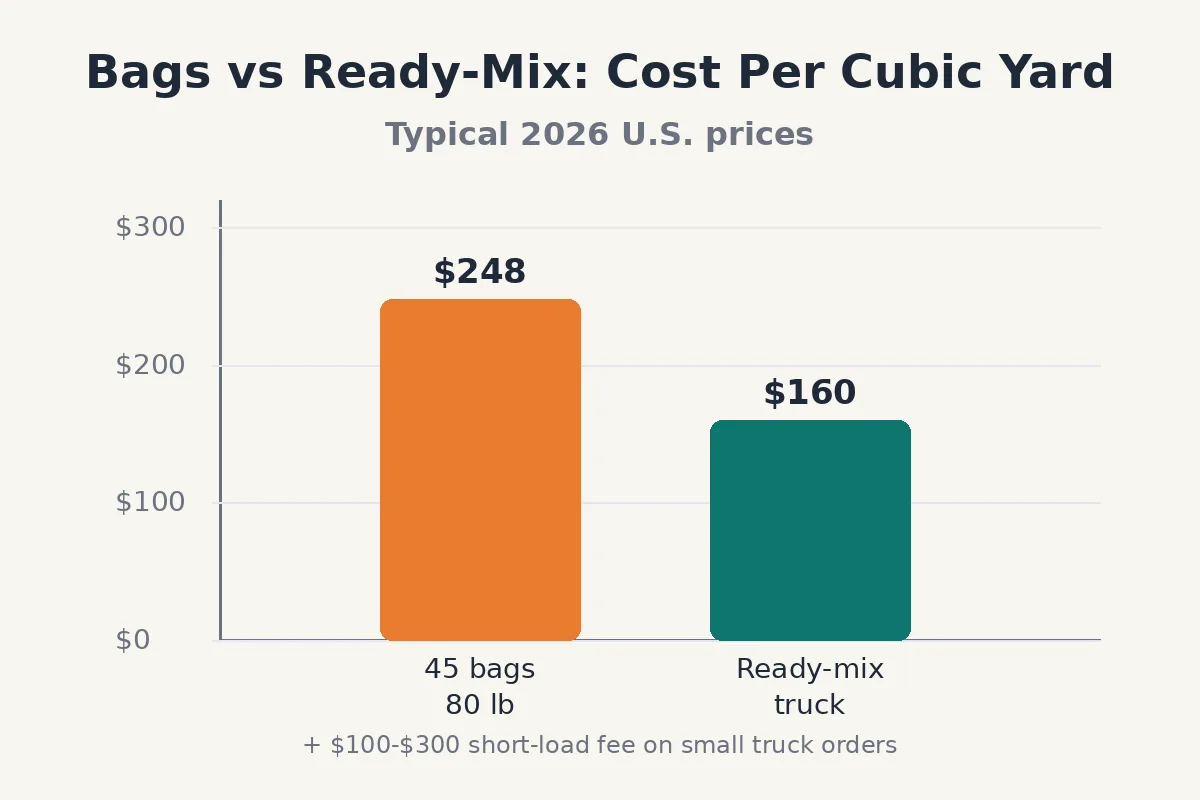
One cubic yard of concrete equals 45 bags of 80 lb premix. Each 80 lb bag yields 0.60 cubic feet, and there are 27 cubic feet in a yard (27 / 0.60 = 45). At typical 2026 big-box prices of $5.00 to $6.50 per 80 lb bag, the material cost of bagged concrete runs $225 to $293 per cubic yard. A ready-mix plant typically charges $140 to $180 per cubic yard delivered, with prices varying by region and mix design. On pure material cost, the truck is cheaper at every volume. The catch is the short-load fee.
| Cost Factor | 80 lb Bags (per cubic yard) | Ready-Mix Truck (per cubic yard) |
|---|---|---|
| Material cost | 45 bags x $5.50 = $247.50 | $140-$180 delivered |
| Labor | 4-6 hours mixing and hauling by hand | 10-30 minutes to discharge |
| Equipment | Mixer rental $50-$75/day, wheelbarrow | Wheelbarrow for longer chutes |
| Minimum order | None, buy a single bag | Short-load fee under 3-4 yards |
| Consistency | Varies batch to batch | Plant-batched, uniform slump |
The Break-Even Point: 1.5 to 2 Cubic Yards
The short-load fee is what moves the break-even point. Most ready-mix suppliers charge a $100 to $300 short-load fee on orders under 3 to 4 cubic yards, because dispatching a mixer truck for a small load costs nearly as much in fuel, driver time, and plant scheduling as a full one. Add that fee to the per-yard price and small truck orders get expensive fast.
| Project Volume | 80 lb Bags Needed | Bags Cost (@ $5.50/bag) | Ready-Mix (@ $160/yd + $150 short fee) | Winner |
|---|---|---|---|---|
| 0.5 yard (small footing) | 23 | $127 | $230 | Bags |
| 1.0 yard (10x10 at 3“) | 45 | $248 | $310 | Bags |
| 1.5 yards (10x10 at 5“) | 68 | $374 | $390 | Bags (close) |
| 2.0 yards (12x16 at 4“) | 90 | $495 | $470 | Truck |
| 3.0 yards (16x16 at 4“) | 135 | $743 | $630 | Truck |
Somewhere between 1.5 and 2 cubic yards the lines cross. Below that, bags win even before you count the labor. Above it, the truck wins on cost, and the labor savings are a bonus. That crossover is the heart of the bags vs ready mix concrete decision: find your volume, read the chart, order accordingly.
💡 Pro Tip: Always call two local plants before you decide. Some waive the short-load fee at 2 yards, and some charge it up to 5. One phone call can move your break-even point by half a yard.
What Counts as a Short Load?
Every plant sets its own minimum, so ask dispatch directly. Common structures include a flat fee under 4 yards, a per-yard surcharge under 3 yards, or a full-truck minimum of 8 to 10 yards with the fee scaling down as your order grows. If your project lands just under a plant’s minimum, consider combining pours: footings plus a walkway, or a patio plus a shed pad, can push you over the threshold and erase the fee entirely.
Labor and Equipment: The Hidden Cost Nobody Puts in the Chart
Cost per yard is only half the story. Mixing 45 bags for a single yard takes one person roughly 4 to 6 hours with a rented electric mixer, including loading, mixing, wheelbarrow runs, and cleanup. A mixer truck discharges a yard in about 10 minutes through the chute, or 20 to 30 minutes if you are wheelbarrowing from the curb. For a 2-yard pour, that is a full day of heavy labor versus under an hour.
Plan your crew honestly. A realistic rule is one helper per cubic yard when mixing bags, because concrete waits for no one: once water hits the mix, you have limited working time, and a tired crew makes a rough slab. Mixer rental runs $50 to $75 per day at most equipment rental yards, which still keeps small bag pours cheaper than a truck, but it narrows the gap.
Can the Truck Reach Your Forms? Access and Logistics
A loaded mixer truck weighs around 33 tons and needs firm, level ground. Measure these three things before you order:
- Chute reach: A standard truck chute reaches 12 to 16 feet from where the truck parks. If your forms sit farther back, you will wheelbarrow every yard, budget one strong helper per two wheelbarrows.
- Ground conditions: Soft soil, fresh fill, or a septic field can swallow a truck axle. When in doubt, ask the dispatcher; they would rather reschedule than tow.
- Gate and overhead clearance: Narrow gates, low branches, and power lines stop trucks cold.
When access rules out the truck, the bags vs ready mix concrete question answers itself: bags win by default, and your real decision becomes how many helpers to recruit. A concrete pump is the middle option for tight sites, but pump hire typically starts around $500 to $1,000, which only pencils out on larger pours.
Timing, Weather, and Cold Joints
Ready-mix concrete must be placed within about 90 minutes of batching (the ASTM C94 limit), and hot weather shortens that window further. The plant, the traffic, and your crew all have to line up. Bags give you the opposite flexibility: mix at your own pace, stop for lunch, or spread the pour across two days with a planned construction joint.
That flexibility cuts both ways. Bag pours that drag on too long create cold joints, weak seams where fresh concrete meets concrete that has already started to set. If you mix bags, keep batches coming steadily and never let the leading edge stiffen before the next wheelbarrow arrives.
Decision Checklist: Bags or Truck?
| Your Situation | Order This |
|---|---|
| Under 1 cubic yard (45 bags or fewer) | Bags, mix by hand or small mixer |
| 1 to 1.5 yards, easy store access | Bags, rent an electric mixer |
| 1.5 to 2 yards | Price both, truck usually wins |
| Over 2 cubic yards | Ready-mix truck |
| Truck cannot reach the forms | Bags, or truck plus pump |
| Pour must span multiple days | Bags, with planned joints |
Frequently Asked Questions
How many 80 lb bags of concrete are in a cubic yard?
Exactly 45. Each 80 lb bag of premix yields 0.60 cubic feet, and a cubic yard holds 27 cubic feet. For 60 lb bags (0.45 cubic feet yield) you need 60 bags per yard, and for 40 lb bags (0.30 cubic feet) you need 90.
What is a concrete short-load fee?
A surcharge ready-mix plants add to small orders, typically under 3 to 4 cubic yards. Fees run $100 to $300 depending on the supplier. The fee exists because running a mixer truck costs nearly the same whether it carries 2 yards or 10.
Can I combine bagged concrete with a ready-mix delivery in one pour?
It is not recommended. Bagged premix and plant-batched concrete can differ in aggregate size, cement content, and color, and the seam between them becomes a weak cold joint. Pick one method for the full pour.
How long do I have to place ready-mix after the truck arrives?
About 90 minutes from the time water is added at the plant, per the ASTM C94 standard. In heat above 90 F, workable time shrinks toward 60 minutes. Have your forms, tools, and crew ready before the truck rolls in.
Is it cheaper to mix my own concrete from cement, sand, and gravel?
The raw materials cost less per yard than premix bags, but you take on sourcing, proportioning, and far more labor. For most homeowners the practical comparison is premix bags versus a ready-mix truck; raw batching only pays off on very large or remote pours.
Get Your Exact Yardage First
Every decision above starts with one number: your pour volume in cubic yards. Enter your slab length, width, and depth in our free Concrete Calculator to get cubic yards, total weight, and exact bag counts for 80 lb, 60 lb, and 40 lb bags in seconds.
Ready to Calculate Your Project?
Enter your exact project dimensions into our verified calculator to get cubic yards, tons, and bags needed.
Open Material Calculator →More in Masonry Guides
View All Guides →Cement vs Concrete: What's the Actual Difference?
Cement vs concrete explained by an engineer: cement is the binder, concrete is the finished mix. Learn the 1-2-3 ratio, bag labels, and when the terms matter.
Standard Cinder Block Dimensions, Weight & Pallet Counts
Master standard CMU sizes, actual weights, and pallet quantities with our expert civil engineering guide to concrete block measurements and ASTM standards.
How Many Bags of Concrete for Post Holes? (4x4 & 6x6 Guide)
Calculate how many bags of concrete for post holes with our engineer's guide. Exact charts for 4x4 and 6x6 posts, bell footings, and frost line depth rules.