How Many Bags of Concrete for Post Holes? (4x4 & 6x6 Guide)
Calculate how many bags of concrete for post holes with our engineer's guide. Exact charts for 4x4 and 6x6 posts, bell footings, and frost line depth rules.

Civil Engineer & Estimator
📑 Table of Contents
- ▸The Core Rule: Hole Diameter and Depth Ratios
- ▸Concrete Bag Count Chart for Post Holes
- ▸How Many Bags of Concrete for Post Holes: The Step-by-Step Formula
- ▸The “Bell Footing” Secret: Why Straight Holes Fail
- ▸Fast-Setting vs. Standard Concrete: Which Mix to Choose?
- ▸3 Critical Post Installation Pitfalls to Avoid
- ▸Frequently Asked Questions
AEO Direct Answer: For a standard 4×4 fence post set in an 8-inch diameter, 36-inch deep hole, you need 3.5 bags of 60 lb concrete (or 2.5 bags of 80 lb concrete). For a heavy-duty 6×6 deck post in a 12-inch diameter, 48-inch deep hole, you need 8.5 bags of 60 lb concrete (or 6.5 bags of 80 lb concrete). Always add 10% to 15% for flared bell footings below the frost line to prevent winter frost heave.
Setting sturdy wooden, vinyl, or steel posts is the structural backbone of fences, pergolas, mailboxes, and deck framing. One of the most frequent dilemmas DIY builders encounter is calculating how many bags of concrete for post holes they need before heading to the lumber yard. Buying too few bags halts your project halfway through mixing, while overbuying leaves you with backbreaking 80-pound sacks hardening in your garage.
Whether you are anchoring a simple privacy fence or framing an elevated deck, estimating your concrete volume with precision requires more than basic cylinder math. You can run custom dimensions instantly using our Concrete Calculator, or follow the geotechnical engineering formulas, diameter ratios, and frost line charts detailed below.
The Core Rule: Hole Diameter and Depth Ratios
Civil engineers and seasoned fence contractors use standard empirical rules to size post holes correctly against lateral wind loads and vertical soil bearing capacity:
- The Diameter Rule (3x Rule): The hole diameter must measure three times the post width.
- A nominal 4×4 post (actual width: 3.5 inches) requires a 10-inch to 12-inch diameter hole for structural deck posts, or a minimum 8-inch diameter hole for standard privacy fencing.
- A nominal 6×6 post (actual width: 5.5 inches) requires a 12-inch to 14-inch diameter hole.
- The Depth Rule (1/3 Rule & Frost Line): At least one-third (33%) to one-half (50%) of the post’s above-ground height must be buried underground.
- A 6-foot privacy fence requires posts buried at least 24 to 36 inches deep.
- In regions with freezing winters, the footing base must extend 6 inches below the local frost line (typically 36 to 48 inches across northern US states and Canada) to prevent frost jacking.
Concrete Bag Count Chart for Post Holes
When referencing the chart below to determine how many bags of concrete for post holes your fence or deck project requires, always round fractional bags up to the nearest whole unit. Calculations deduct the displaced volume of the submerged wooden post and incorporate a 4-inch compacted gravel drainage base.
| Post Size | Hole Diameter | Hole Depth | Submerged Post Volume | 80 lb Bags Needed (0.60 cu ft yield) | 60 lb Bags Needed (0.45 cu ft yield) | 50 lb Fast-Setting Bags (0.37 cu ft yield) |
|---|---|---|---|---|---|---|
| 4×4 Post | 8 Inches | 24 Inches | 0.17 cu ft | 1.5 Bags (2 w/ safety) | 2.0 Bags (2.5 w/ safety) | 2.5 Bags (3 w/ safety) |
| 4×4 Post | 8 Inches | 36 Inches | 0.25 cu ft | 2.5 Bags (3 w/ safety) | 3.5 Bags (4 w/ safety) | 4.0 Bags (4.5 w/ safety) |
| 4×4 Post | 10 Inches | 36 Inches | 0.25 cu ft | 3.5 Bags (4 w/ safety) | 4.5 Bags (5 w/ safety) | 5.5 Bags (6 w/ safety) |
| 4×4 Post | 10 Inches | 48 Inches (Frost) | 0.34 cu ft | 4.5 Bags (5 w/ safety) | 6.0 Bags (7 w/ safety) | 7.5 Bags (8.5 w/ safety) |
| 6×6 Post | 10 Inches | 36 Inches | 0.63 cu ft | 3.0 Bags (3.5 w/ safety) | 4.0 Bags (4.5 w/ safety) | 5.0 Bags (6 w/ safety) |
| 6×6 Post | 12 Inches | 36 Inches | 0.63 cu ft | 4.5 Bags (5 w/ safety) | 6.0 Bags (7 w/ safety) | 7.5 Bags (8.5 w/ safety) |
| 6×6 Post | 12 Inches | 48 Inches (Frost) | 0.84 cu ft | 6.5 Bags (7 w/ safety) | 8.5 Bags (9.5 w/ safety) | 10.5 Bags (12 w/ safety) |
| 8×8 Post | 14 Inches | 48 Inches (Frost) | 1.36 cu ft | 8.5 Bags (9.5 w/ safety) | 11.5 Bags (13 w/ safety) | 14.0 Bags (16 w/ safety) |
How Many Bags of Concrete for Post Holes: The Step-by-Step Formula
If your post dimensions or auger bit diameters differ from the standard matrix above, calculate your exact bag requirements using this four-step engineering formula:
Step 1: Calculate the Cylindrical Hole Volume
Convert all measurements from inches into feet by dividing by 12: $$\text{Radius } (r) = \frac{\text{Diameter in inches}}{2 \times 12}$$ $$\text{Hole Volume } (V_{\text{hole}}) = \pi \times r^2 \times \text{Depth in feet}$$
Example: For a 10-inch diameter hole drilled 3 feet (36 inches) deep:
- Radius $r = 5 \div 12 = 0.4167 \text{ ft}$
- $V_{\text{hole}} = 3.1416 \times (0.4167)^2 \times 3 = 1.636 \text{ cubic feet}$
Step 2: Deduct the Displaced Post Volume
A wooden post occupies space inside the cylinder, displacing wet concrete: $$\text{Post Volume } (V_{\text{post}}) = \text{Width (ft)} \times \text{Thickness (ft)} \times \text{Depth in Concrete (ft)}$$
Example: A 4×4 post (actual 3.5“ × 3.5“) embedded 2.66 feet (32 inches, allowing 4 inches of gravel at bottom):
- $V_{\text{post}} = (3.5 \div 12) \times (3.5 \div 12) \times 2.66 = 0.226 \text{ cubic feet}$
Step 3: Compute Net Concrete Volume
$$\text{Net Volume} = V_{\text{hole}} - V_{\text{post}} = 1.636 - 0.226 = 1.41 \text{ cubic feet}$$
Step 4: Convert Net Volume to Bags
Divide the net cubic feet by the manufacturer’s yield rating per bag:
- 80 lb Bag Yield: $0.60 \text{ cu ft}$ $\rightarrow 1.41 \div 0.60 = \mathbf{2.35 \text{ bags}}$
- 60 lb Bag Yield: $0.45 \text{ cu ft}$ $\rightarrow 1.41 \div 0.45 = \mathbf{3.13 \text{ bags}}$
- 50 lb Fast-Setting Bag Yield: $0.37 \text{ cu ft}$ $\rightarrow 1.41 \div 0.37 = \mathbf{3.81 \text{ bags}}$
By working through these geometric calculations, determining how many bags of concrete for post holes of non-standard depth or auger diameters becomes completely repeatable.
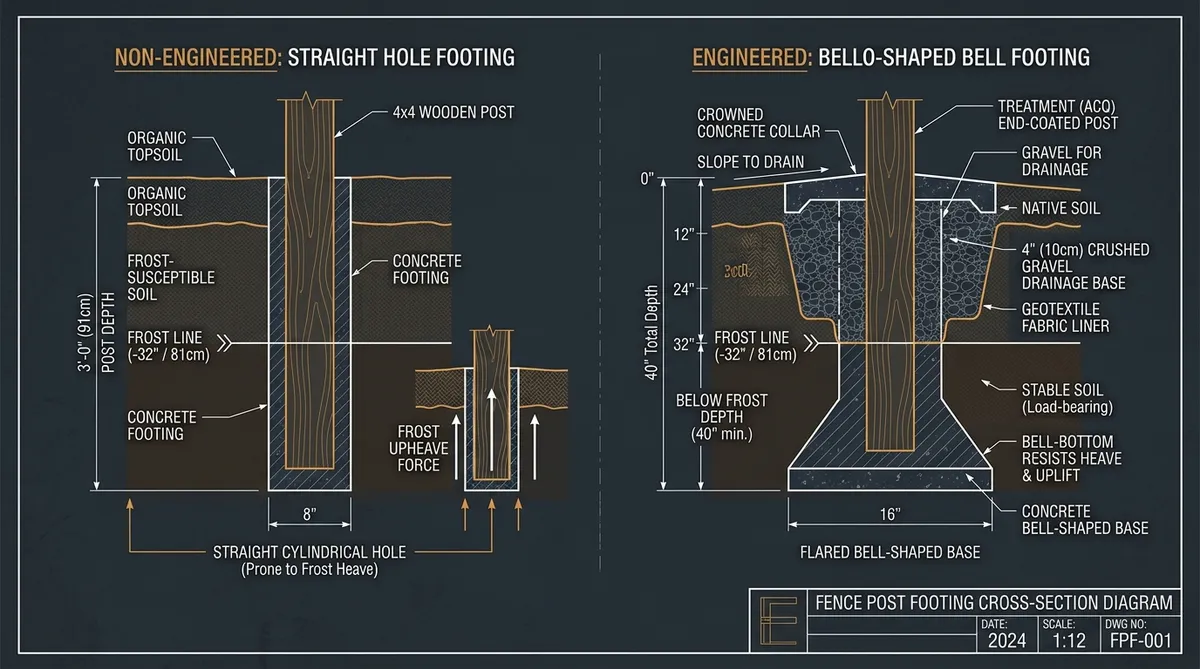
The “Bell Footing” Secret: Why Straight Holes Fail
Online cylindrical calculators frequently leave DIYers short on concrete because real augers wobble during drilling, creating an irregular cavity. More importantly, building codes in freeze-thaw zones demand a flared bell-bottom footing.
    UN-ENGINEERED (Straight)               ENGINEERED (Bell-Bottom)
           │      │                               │      │
           │ Post │                               │ Post │
     ┌─────┴──────┴─────┐                   ┌─────┴──────┴─────┐
     │ ░░░ Concrete ░░░ │                   │ ░░░ Concrete ░░░ │
     │ ░░░░░░░░░░░░░░░░ │                   │ ░░░░░░░░░░░░░░░░ │
     │ ░░░░░░░░░░░░░░░░ │ ◄ Frost Heave    │ ░░░░░░░░░░░░░░░░ │
     │ ░░░░░░░░░░░░░░░░ │   Forces Upward   │ ░░░░░░░░░░░░░░░░ │
     │ ░░░░░░░░░░░░░░░░ │                   └───┐ ░░░░░░ ┌────┘
     │ ░░░░░░░░░░░░░░░░ │                       │ ░░░░░░ │ ◄ Flared Bell Resists
     └──────────────────┘                       └────────┘   Upward Heave Forces
When frozen soil expands, it grips the parallel sides of a straight concrete cylinder and jacks the entire post out of the ground. By using a post hole digging shovel or specialized auger blade to flare the bottom 10 inches of the hole outward by 4 to 6 inches, you form a concrete plug. The wedge of compacted soil above the flared footing locks the assembly securely down.
This geological phenomenon explains why basic cylindrical calculators miscalculate how many bags of concrete for post holes are needed on actual job sites. Flaring the footing adds 0.4 to 0.7 cubic feet of volume, which requires 1 additional 60 lb or 80 lb bag per hole.
Fast-Setting vs. Standard Concrete: Which Mix to Choose?
Another practical variable that impacts how many bags of concrete for post holes you should purchase is whether you choose rapid-setting or standard high-strength bagged concrete. When purchasing concrete at commercial home improvement centers, you will encounter two primary formulations:
1. Fast-Setting Concrete (e.g., Quikrete Fast-Set / Sakrete Fast-Setting)
- How It Works: Formulated with rapid-hardening hydraulic cements and fine aggregates. You do not pre-mix this in a wheelbarrow; you pour the dry powder directly around the plumbed post and saturate it with water inside the hole.
- Set Time: Sets firm in 20 to 40 minutes; ready for heavy fence boards or rails in 4 hours.
- Strength: Reaches approximately 4,000 PSI compressive strength at 28 days.
- Best Use: Vertical line posts for privacy fencing, mailboxes, and gate latch posts where propping braces for 24 hours is inconvenient.
2. Standard High-Strength Concrete (e.g., Quikrete 4000 / Sakrete Maximizer)
- How It Works: Traditional Portland cement blended with sand and coarse stone gravel aggregates (ASTM C387 compliant). Must be pre-mixed thoroughly with clean water in a drum mixer or mortar tub to achieve uniform slump.
- Set Time: Initial set in 2 to 4 hours; requires 24 to 48 hours before framing load-bearing members.
- Strength: Reaches 4,000 to 5,000 PSI.
- Best Use: Structural deck posts, pergolas, retaining wall pilings, and gate hinge posts carrying heavy dynamic torque loads.
3 Critical Post Installation Pitfalls to Avoid
Pitfall 1: Pouring Concrete Completely Under the Post Base
Never encase the bottom timber end grain completely inside a cup of concrete. Water seeping down the post face will pool at the bottom, rotting pressure-treated wood in fewer than five years. Always tamp down 4 inches of clean crushed drainage gravel (#57 stone) at the base of the excavated hole, set the post directly on top of the gravel, and pour the concrete sleeve around the sides.
Pitfall 2: Finishing the Surface Below Grade
Terminating the concrete pour below the lawn surface leaves a hollow that captures runoff, saturating the ground-line collar where wood decay fungi thrive. Pour concrete until it rises 1 to 2 inches above the soil line, then trowel the wet surface outward into a slight slope (crown) away from the post face to shed rainwater.
Pitfall 3: Guessing Water Content
Adding excess water makes concrete easier to pour down narrow holes, but severely degrades final compressive strength. Contractors who miscalculate how many bags of concrete for post holes they need often try to stretch their mix by over-watering the final batch, which dramatically weakens the cured footing. Every extra quart of water added above the manufacturer’s specified water-to-cement ratio reduces PSI by up to 40% and drastically increases surface freeze-thaw cracking.
Frequently Asked Questions
Can I pour dry concrete in the hole and add water on top?
Only if you are using specifically formulated fast-setting concrete labeled for no-mix installation. Standard high-strength concrete mixes contain coarse gravel that will not hydrate evenly without mechanical pre-mixing. Adding water to standard dry concrete leaves unhydrated pockets of dry powder deep in the hole, leading to structural post failure.
How much weight can a concrete post footing hold?
In cohesive soil with a safe bearing capacity of 2,000 lbs per square foot (PSF), a 12-inch diameter circular footing safely carries approximately 1,570 lbs of dead and live load. A 16-inch bell-flared footing carries over 2,800 lbs, making it suitable for multi-level deck support columns.
Why do online calculators underestimate how many bags of concrete for post holes are needed?
Most online calculators assume perfect, smooth mathematical cylinders. In real earthwork, auger bits wobble, soil collapses along the edges, and tree roots widen excavations. Additionally, they neglect the extra concrete volume needed for flared bell footings and surface crowns, leading to shortages of 15% to 25%.
Ready to Calculate Your Project?
Enter your exact project dimensions into our verified calculator to get cubic yards, tons, and bags needed.
Open Material Calculator →More in Masonry Guides
View All Guides →Standard Cinder Block Dimensions, Weight & Pallet Counts
Master standard CMU sizes, actual weights, and pallet quantities with our expert civil engineering guide to concrete block measurements and ASTM standards.
How Many Concrete Bags for Slab Projects? 10x10 Patio Guide
Planning a 10x10 patio? Learn exactly how many concrete bags you need for a 3", 4", 5", or 6" slab. Avoid cold joints with our expert calculator guide.
How to Build a Long-Lasting Gravel Driveway Base: #57 Stone vs. Crusher Run
Learn how to build a durable gravel driveway base. Compare #57 washed stone vs. crusher run, understand compaction rules, and calculate exact tonnage.