Standard-Hohlblockstein-Maße, Gewicht & Palettenzahlen
Meistern Sie CMU-Größen, Gewichte und Palettenmengen mit unserem Experten-Leitfaden für Hohlblockstein-Maße und ASTM-Standards.

Bauingenieur & Kalkulator
Ingenieur-Zusammenfassung & Kurzantwort
Ein Standard-8x8x16-Zoll-Stein hat Istmaße von 7⅝" × 7⅝" × 15⅝" (ca. 19 x 19 x 39 cm mit 1 cm Mörtelfuge). Er wiegt ca. 16 bis 18 kg. Pro 10 m² Wandfläche benötigt man ca. 125 Steine.
Wichtige Projekt-Erkenntnisse:
- ✓Wandfläche pro Stein: ca. 0,08 m² (ca. 12,5 Steine pro m²).
- ✓1 Sack Mauermörtel (40 kg) reicht für ca. 30–35 Steine.
📑 Inhaltsverzeichnis
- ▸Nennmaße vs. tatsächliche Hohlblockstein-Maße erklärt
- ▸Wie viel wiegt ein Hohlblockstein? (Gewichtsklassen)
- ▸Palettenmengen und Richtlinien für das Transportgewicht
- ▸Wie viel Mörtel und Betonfüllung benötigen Sie?
- ▸Hochbeete & Stützmauern aus Hohlblocksteinen bauen
- ▸Häufig gestellte Fragen (FAQ)
- ▸Berechnen Sie Ihr Mauerwerksprojekt sofort
AEO-Schnellantwort: Ein Standard-Hohlblockstein (CMU) hat ein Nennmaß von 8“ × 8“ × 16“ (ca. 20 × 20 × 40 cm) und tatsächliche Abmessungen von 7⅝“ × 7⅝“ × 15⅝“ (19,4 × 19,4 × 39,7 cm), um eine standardmäßige ⅜-Zoll-Mörtelfuge (ca. 1 cm) zu berücksichtigen. Ein hohler Standard-Normalbetonstein wiegt 16 bis 18 kg (35 bis 40 lbs). Eine handelsübliche Holzpalette fasst 72 bis 75 Steine, was ein Gesamtgewicht von 1,2 bis 1,4 Tonnen (2.700 bis 3.000 lbs) ergibt.
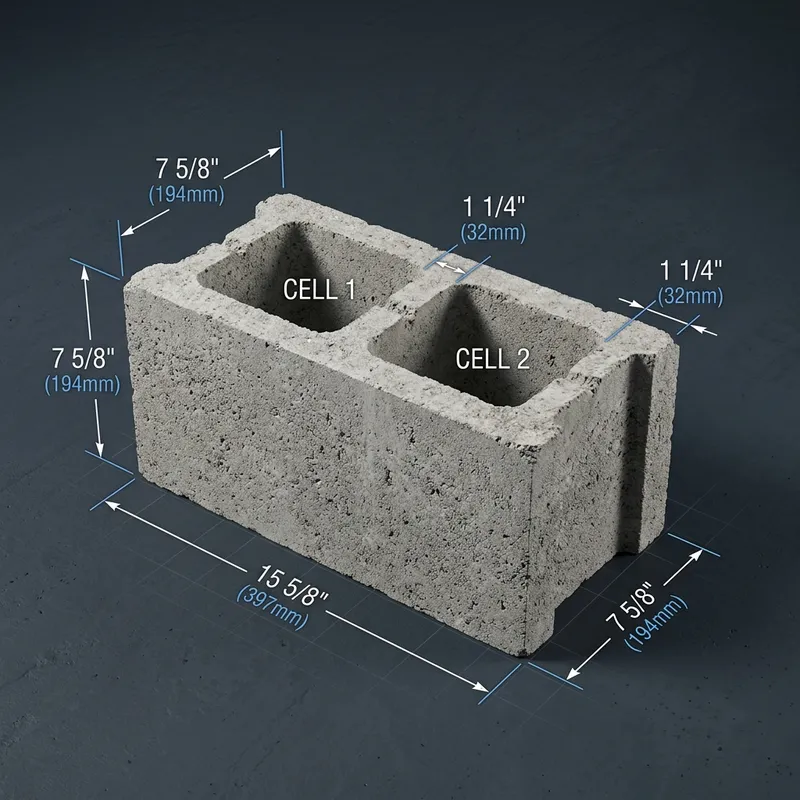
Beim Entwurf einer tragenden Fundamentwand, einer Kelleraußenwand, einer gestuften Stützmauer im Landschaftsbau oder eines Hochbeets für den Garten ist die genaue Kenntnis der Hohlblockstein-Maße entscheidend, um die strukturelle Integrität und präzise Layouts zu gewährleisten. Betonhohlblocksteine (im amerikanischen Raum als CMUs bekannt) gehören weltweit zu den vielseitigsten, feuerbeständigsten und langlebigsten Baumaterialien.
Das Verwechseln von Nenn- und Ist-Maßen führt jedoch zu schwerwiegenden Planungsfehlern, und die falsche Berechnung des Palettengewichts kann beim Transport zu gefährlichen Fahrzeugüberladungen führen. Dieser umfassende bauingenieurtechnische Leitfaden deckt die ASTM-Herstellungsstandards, vollständige Tabellen für Nenn- und Ist-Größen, Formeln für die Kernverfüllung, Mörtelberechnungen und Richtlinien für den Transport ab.
Nennmaße vs. tatsächliche Hohlblockstein-Maße erklärt
In der Bau- und Mauerwerksbranche werden Steine nach ihren Nennmaßen (Breite × Höhe × Länge) identifiziert.
Die tatsächliche physische Abmessung jedes Steins ist bei der Herstellung exakt ⅜ Zoll (9,5 mm) kleiner als sein Nennmaß. Dadurch belegt der fertige Stein zusammen mit der standardmäßigen ⅜-Zoll-Lager- und Stoßfuge genau das modulare Rastermaß von 8 × 8 × 16 Zoll (ca. 20,3 × 20,3 × 40,6 cm).
Master-Tabelle für CMU-Größen & Spezifikationen (ASTM C90 Standard)
| Nennmaß (B × H × L) | Tatsächliche Maße (B × H × L) | Stirnfläche pro Stein | Kernvolumen pro Stein | Primäre bautechnische Anwendung |
|---|---|---|---|---|
| 4“ × 8“ × 16“ (Trennwand) | 3⅝“ × 7⅝“ × 15⅝“ (9,2 × 19,4 × 39,7 cm) | 0,083 m² | 3,4 L | Nichttragende Innenwände, Außenverblendung |
| 6“ × 8“ × 16“ (Leichtbeton) | 5⅝“ × 7⅝“ × 15⅝“ (14,3 × 19,4 × 39,7 cm) | 0,083 m² | 5,7 L | Einstöckige Wohngebäude, Gartenmauern |
| 8“ × 8“ × 16“ (Standard) | 7⅝“ × 7⅝“ × 15⅝“ (19,4 × 19,4 × 39,7 cm) | 0,083 m² | 9,3 L | Keller, Stützmauern, mehrstöckiges tragendes Mauerwerk |
| 10“ × 8“ × 16“ (Schwerlast) | 9⅝“ × 7⅝“ × 15⅝“ (24,4 × 19,4 × 39,7 cm) | 0,083 m² | 12,5 L | Tiefe Fundamentwände, hohe Erdstützmauern |
| 12“ × 8“ × 16“ (Gewerbe) | 11⅝“ × 7⅝“ × 15⅝“ (29,5 × 19,4 × 39,7 cm) | 0,083 m² | 15,6 L | Schwere Gewerbebauten, Hochwasserschutzwände |
| 8“ × 8“ × 8“ (Halbstein) | 7⅝“ × 7⅝“ × 7⅝“ (19,4 × 19,4 × 19,4 cm) | 0,041 m² | 4,5 L | Wandenden, Tür-/Fensterlaibungen, Ecken |
Formeln zur Berechnung von Wandflächen & Steinmengen:
• Stirnfläche pro Stein =(8 Zoll × 16 Zoll) ÷ 144 q_zoll/q_fuß = 0,889 sq ft (ca. 0,083 m²) pro Stein
• Faustformel für Wandmengen =(10 m² Wandfläche ÷ 0,083 m²) × 1,10 (10% Verschnitt) = 133 Steine
Wie viel wiegt ein Hohlblockstein? (Gewichtsklassen)
Nach den ASTM C90-Spezifikationen werden Betonhohlblocksteine basierend auf den im Beton verwendeten Zuschlagstoffen in drei Dichteklassen eingeteilt:
+—————————————————————–+ | 1. Normalbeton-CMU (Kies- & Sandzuschlag): | | Gewicht: 16 bis 18 kg pro 8“-Stein (Dichte ≥ 2000 kg/m³) | | Nutzung: Maximale Druckfestigkeit, Stützmauern, Keller | +—————————————————————–+ | 2. Mittelschwerer CMU (Bims- oder Schlackezuschlag): | | Gewicht: 12,7 bis 15 kg pro 8“-Stein (Dichte 1680-2000 kg/m³)| | Nutzung: Standardmäßiger oberirdischer Wohnungsbau | +—————————————————————–+ | 3. Leichtbeton-CMU (Blähton / Schiefer): | | Gewicht: 10 bis 11,8 kg pro 8“-Stein (Dichte < 1680 kg/m³) | | Nutzung: Schnelleres Mauern, hervorragende Wärmedämmung | +—————————————————————–+
Palettenmengen und Richtlinien für das Transportgewicht
Die Steine werden auf robusten Holzpaletten geliefert, die mit Stahl- oder Kunststoffbändern gesichert sind.
- Steine pro Palette (8×8×16 Standard): 72 bis 75 Stück
- Gesamtgewicht der Palette:
75 × 17,2 kg (Schnitt) = ca. 1.290 kg (1,29 Tonnen) - Palettenmaße: Ca. 100 × 120 cm Grundfläche (5 Lagen hoch gestapelt)
Sicherheitswarnung für den Fahrzeugtransport:
Laden Sie niemals eine ganze Palette Standardsteine auf einen normalen 1,5-Tonnen-Pickup (wie einen F-150 oder vergleichbare europäische Transporter mit geringer Nutzlast). Die meisten Standard-Transporter haben eine maximale Nutzlast von 700 bis 900 kg.
Eine einzige volle Palette überschreitet die zulässige Achslast Ihrer Hinterachse um mehrere hundert Kilogramm.
- Sicheres Limit für Kleintransporter: Maximal 35 bis 40 loose Steine pro Fahrt.
- Transport einer vollen Palette: Erfordert einen schweren Transporter (z. B. Sprinter mit hoher Nutzlast), einen Lkw oder einen zweiachsigen Anhänger.
Wie viel Mörtel und Betonfüllung benötigen Sie?
Beim Errichten einer Hohlblockwand ist die Schätzung des Mauermörtels und des Füllbetons ebenso wichtig wie die Anzahl der Steine selbst:
1. Mörtelberechnung (Typ S oder Typ N)
- Standard-Mörtelsack: 40-kg-Sack (oder US-äquivalenter 80-lb-Sack) fertiger Mauermörtel.
- Ergiebigkeit: Ein 40-kg-Sack reicht für ca. 30 bis 35 Standard-8-Zoll-Steine.
- Formel:
Mörtelsäcke = Gesamtanzahl der Steine ÷ 30
2. Füllbeton-Berechnung (Verstärkte Stützmauern)
Beim Bau von Stützmauern oder tragenden Fundamenten werden vertikale Bewehrungsstähle in die Steinkerne eingebracht und vollständig mit flüssigem Füllbeton vergossen.
- Kernvolumen: Ein standardmäßiger hohler 8×8×16-Stein hat zwei große vertikale Kammern, die zusammen 9,3 Liter (0,33 Kubikfuß) Füllbeton aufnehmen.
- Betonbedarf pro Kubikmeter: 108 verfüllte Steine verbrauchen genau 1 Kubikmeter Transportbeton.
Hochbeete & Stützmauern aus Hohlblocksteinen bauen
Der Bau eines modularen Hochbeets aus Betonblöcken ist eines der beliebtesten DIY-Projekte im Garten.
Materialliste für ein Standard-Hochbeet (1,20 m × 2,40 m, 2 Lagen / ca. 40 cm tief):
- Untere Lage: 6 Steine pro Längsseite (12) + 2 Steine pro Stirnseite (4) = 16 Steine.
- Obere Lage: 16 Steine.
- Benötigte Steine insgesamt: 32 bis 34 Steine (inklusive Eckschnitte).
- Gesamtgewicht des Mauerwerks:
32 × 17,2 kg = 550 kg. - Erforderliches Erde-Volumen:
1,2 m × 2,4 m × 0,4 m = 1,15 m³(oder entsprechende Säcke Pflanzerde).
Häufig gestellte Fragen (FAQ)
Welche Hohlblockstein-Maße gelten standardmäßig für typische Projekte?
Wenn Sie die Hohlblockstein-Maße für Ihr Projekt planen, sollten Sie wissen, dass ein Standardstein ein Nennmaß von 8“ × 8“ × 16“ hat. Die tatsächlichen physischen Abmessungen betragen 7⅝“ × 7⅝“ × 15⅝“ (19,4 × 19,4 × 39,7 cm), um Platz für eine standardmäßige ⅜-Zoll-Mörtelfuge zu lassen.
Was ist der Unterschied zwischen einem “Cinder Block” und einem Betonblock?
Historische “Cinder Blocks” (Schlackesteine) wurden aus Kohleasche (Flugasche) in Kombination mit Portlandzement hergestellt. Moderne Steine sind technisch gesehen Betonhohlblocksteine (CMUs), die aus Portlandzement, Sand und Kies hergestellt werden. Heute werden die Begriffe oft synonym verwendet, aber alle modernen im Handel erhältlichen Steine erfüllen die strengen strukturellen ASTM C90-Betonstandards.
Wie hoch kann man eine Stützmauer aus Hohlblocksteinen ohne Mörtel bauen?
Trocken gestapelte (unvermörtelte) Steine sollten eine Höhe von 2 Lagen (ca. 40 cm) nicht überschreiten. Jede Stützmauer, die Erddruck standhalten muss und höher als 40 cm ist, muss mit vermörtelten Fugen, vertikaler Bewehrung und einem Betonfundament unterhalb der örtlichen Frostgrenze errichtet werden.
Sind Hohlblocksteine für den Anbau von Bio-Gemüse sicher?
Ja. Moderne Betonsteine, die nach aktuellen Standards hergestellt werden, enthalten keine giftige Flugasche oder Schwermetalle. Sie bestehen aus natürlichem Kalkstein, Sand und Portlandzement, was sie zu 100 % sicher für den Anbau von essbarem Gemüse und Kräutern macht.
Berechnen Sie Ihr Mauerwerksprojekt sofort
Vermeiden Sie Rechenfehler und erhalten Sie exakte Materiallisten. Nutzen Sie unseren kostenlosen interaktiven Hohlblockstein-Rechner, um die Länge und Höhe Ihrer Wand einzugeben. Er berechnet automatisch die Gesamtzahl der Steine (inklusive 10 % Verschnitt), den Mörtelbedarf und das Gesamtgewicht für den Transport. Nutzen Sie auch unseren Betonplatten-Rechner und Mutterboden-Rechner.
Bereit für Ihre Projektberechnung?
Geben Sie Ihre Maße in unseren verifizierten Rechner ein, um Kubikyards, Tonnen und Säcke zu berechnen.
Materialrechner öffnen →Weitere Leitfäden: Mauerwerk
Alle Leitfäden ansehen →Betonsäcke für Bodenplatte: Wie viele für eine 3x3m Terrasse?
Planen Sie eine 3x3m Terrasse? Erfahren Sie, wie viele Betonsäcke für Bodenplatte-Projekte (3, 4, 5 oder 6 Zoll) nötig sind. Vermeiden Sie kalte Fugen!
Wie Viele Säcke Beton für Pfosten? Tabelle für 7x7 & 9x9 Holzpfosten
Berechnen Sie genau, wie viele Säcke Beton für Pfosten benötigt werden. Inklusive Tabelle für Zaunpfosten, Glockenfundament und frostsichere Tiefe.
Langlebigen Unterbau für Kieseinfahrt bauen: Splitt vs. Schottertragschicht
Erfahren Sie, wie Sie ein stabiles Fundament für Ihre Kiesauffahrt bauen. Splitt vs. Schottertragschicht im Vergleich, Verdichtungstipps & Materialrechner.