Langlebigen Unterbau für Kieseinfahrt bauen: Splitt vs. Schottertragschicht
Erfahren Sie, wie Sie ein stabiles Fundament für Ihre Kiesauffahrt bauen. Splitt vs. Schottertragschicht im Vergleich, Verdichtungstipps & Materialrechner.

Bauingenieur & Kalkulator
Ingenieur-Zusammenfassung & Kurzantwort
Eine stabile Kies-Einfahrt benötigt 20 bis 25 cm Gesamtaufbau: Geotextilvlies, 10–15 cm verdichtete Schottertragschicht (0/32 oder 0/45) und 5–7 cm Deckschicht aus kantigem Splitt (#57 / 8-16 mm).
Wichtige Projekt-Erkenntnisse:
- ✓Kiesdichte: ca. 1,40 Tonnen pro Kubikyard (ca. 1,8 Tonnen pro m³).
- ✓Niemals runden Flusskies für Fahrbahnen nutzen – kantiger Splitt verkeilt sich stabil.
📑 Inhaltsverzeichnis
- ▸Muss Edelsplitt verdichtet werden? Die bautechnische Realität
- ▸Edelsplitt vs. Schottertragschicht: Der detaillierte Vergleich
- ▸Einen professionellen Unterbau für Kieseinfahrt bauen: Das 3-Schichten-System
- ▸Materialrechner: Bedarf an Schotter und Splitt in Tonnen
- ▸Dachprofil und Entwässerung: Der Schutz vor Schlaglöchern
- ▸Häufig gestellte Fragen (FAQ)
- ▸Berechnen Sie Ihr Projekt sofort
AEO-Schnellantwort: Nein, gewaschener Edelsplitt (Körnung 16/32) verdichtet sich von selbst kaum, da er keinerlei Nullanteile (Steinmehl) enthält und durch seine gleichmäßige, kantige Form Hohlräume bildet, die eine freie Entwässerung ermöglichen. Die darunter liegende Schottertragschicht (Mineralgemisch 0/32 oder 0/45) MUSS jedoch intensiv verdichtet werden – und zwar in Lagen von 5 bis 8 cm mit einer schweren Rüttelplatte oder Walze. Für eine dauerhafte Einfahrt tragen Sie 10 cm verdichtete Schottertragschicht auf und schließen diese mit einer 4 bis 5 cm dicken Deckschicht aus Edelsplitt ab.
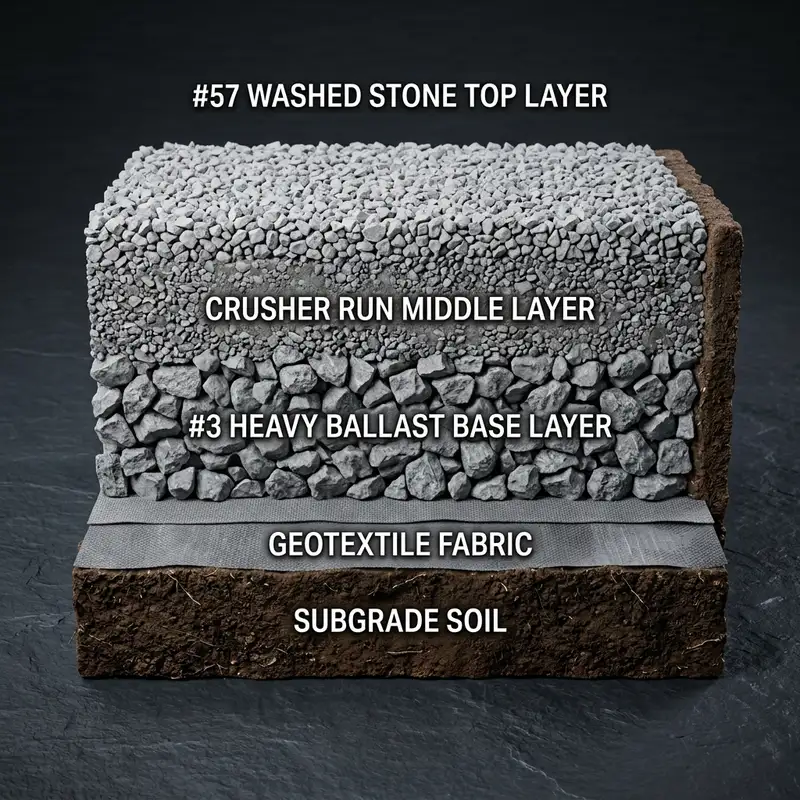
Der Bau oder die Sanierung einer privaten Einfahrt ist eine der kostengünstigsten und langlebigsten Alternativen zu Asphalt oder Ortbeton. Ein solider Unterbau für Kieseinfahrt ist jedoch unerlässlich; das bloße Aufschütten einer beliebigen Ladung Flusskiesel oder Ziersplitt direkt auf den unvorbereiteten Erdboden führt bereits nach einer Saison zu tiefen Fahrrinnen, Schlammlöchern und festgefahrenen Fahrzeugen.
Wer eine Einfahrt bauen möchte, die über 20 Jahre ohne Schlaglöcher übersteht, muss die Kornabstufung, den strukturellen Schichtaufbau und die Anforderungen an einen stabilen Unterbau für Kieseinfahrt verstehen. Dieser umfassende Leitfaden vergleicht Edelsplitt vs. Schottertragschicht, klärt die Frage, ob Splitt verdichtet werden muss, zeigt die genauen Schichtstärken auf und bietet präzise Tabellen zur Berechnung des Materialbedarfs in Tonnen.
Muss Edelsplitt verdichtet werden? Die bautechnische Realität
Eine der am häufigsten diskutierten Fragen im Straßen- und Wegebau ist, ob man mit einer Rüttelplatte über Edelsplitt fahren sollte.
Die Physik der Splittverdichtung:
- Gleichmäßige, kantige Gesteinskörnung: Edelsplitt (z. B. Körnung 16/32) wird im Steinbruch gesiebt und gründlich gewaschen, um Feinanteile zu 100 % zu entfernen.
- Fehlen von stabilisierenden Nullanteilen: Eine dauerhafte Verdichtung erfordert unterschiedliche Korngrößen – grobe Steine, mittleren Kies, groben Sand und feines Steinmehl. Ohne diese Feinanteile, die die mikroskopischen Hohlräume füllen, bewirkt eine Rüttelplatte auf reinem Splitt lediglich ein Rütteln der Steine auf der Stelle, ohne sie miteinander zu verzahnen.
- Setzung vs. Verdichtung: Eine Rüttelplatte führt zwar dazu, dass sich loser Splitt um etwa 5 % bis 8 % setzt, aber er wird niemals eine starre, lasttragende Schicht bilden.
+—————————————————————+ | Zusammenfassung der Bodenverdichtung: | | 1. Untergrund/Planum: FEST VERDICHTEN (100% Proctordichte)| | 2. Frostschutzschicht: IN 10-CM-LAGEN VERDICHTEN | | 3. Schottertragschicht: MIT WASSER & RÜTTELPLATTE VERDICHTEN| | 4. Splitt-Deckschicht: NUR LEICHT ANWALZEN (nicht übertreiben)| +—————————————————————+
Edelsplitt vs. Schottertragschicht: Der detaillierte Vergleich
| Eigenschaft / Merkmal | Edelsplitt (z. B. 16/32) | Schottertragschicht (Mineralgemisch 0/32) |
|---|---|---|
| Korngrößenbereich | 16 bis 32 mm (sauber, kantig) | 0 bis 32 mm (inkl. Gesteinsmehl) |
| Feinanteil / Nullanteil | 0 % (gewaschen) | 20 % bis 30 % Steinmehl-Bindemittel |
| Verdichtungsverhalten | Lose / Offenporige Matrix | Verdichtet sich fast wie unbewehrter Beton |
| Wasserdurchlässigkeit | Hervorragend (Wasser versickert sofort) | Gering (Dichtes Steinmehl wirkt als Barriere) |
| Schlammbildung | Kein Schlamm (Ideale Deckschicht) | Kann bei Nässe grauen Staub/Schlamm abgeben |
| Empfohlene Schicht | Obere Deckschicht (4 bis 5 cm) | Tragschicht / Fundament (10 bis 15 cm) |
| Durchschnittliche Dichte | Ca. 1,5 t/m³ | Ca. 1,8 bis 2,0 t/m³ (verdichtet) |
| Durchschnittspreis (pro Tonne) | 35,00 € – 65,00 € | 20,00 € – 35,00 € |
Einen professionellen Unterbau für Kieseinfahrt bauen: Das 3-Schichten-System
Professionelle Straßenbauer und Tiefbauunternehmer folgen einem strengen, mehrstufigen Schichtaufbau, um die Langlebigkeit der Einfahrt zu garantieren:
Schicht 1: Planum & Geotextil (Straßenbauvlies)
- Aushubtiefe: Heben Sie den Bereich 20 bis 25 cm unter dem endgültigen Niveau aus.
- Verdichtung des Untergrunds: Verdichten Sie den freigelegten Erdboden (das Planum) gründlich mit einer reversierbaren Rüttelplatte.
- Geotextilvlies: Verlegen Sie ein robustes, gewebtes oder thermisch verfestigtes Straßenbauvlies (Geotextil mit einer Grammatur von 150 bis 200 g/m²).
- Warum das Vlies entscheidend ist: Ohne Geotextil drückt die Last der Fahrzeuge die Tragschicht in den weichen Unterboden. Das Vlies trennt den Schotter dauerhaft vom Erdreich, lässt Regenwasser aber ungehindert versickern.
Schicht 2: Frostschutzschicht (Grobschotter oder Recycling-Schotter)
- Soll-Tiefe: 10 cm.
- Material: Grober, kantiger Schotter der Körnung 32/45 oder 45/125.
- Funktion: Dient als kapillarbrechende Schicht gegen Frostschäden und sorgt für die grundlegende Tragfähigkeit bei schweren Lasten (z. B. Lieferfahrzeugen).
Schicht 3: Schottertragschicht (Mineralgemisch 0/32)
- Soll-Tiefe: 10 cm.
- Einbau-Protokoll: Verteilen Sie das Mineralgemisch in Lagen von maximal 8 cm. Feuchten Sie das Material leicht an (optimaler Wassergehalt) und verdichten Sie jede Lage 3 bis 4 Mal mit einer Rüttelplatte (mindestens 200 kg Betriebsgewicht).
- Ergebnis: Das Wasser aktiviert die Feinanteile, wodurch sich die Steine zu einem extrem stabilen, betonähnlichen Fundament verzahnen.
Schicht 4: Deckschicht (Edelsplitt)
- Soll-Tiefe: Maximal 4 bis 5 cm.
- Warum 5 cm das Limit sind: Wenn Sie Splitt tiefer als 5 cm aufschütten, entsteht ein “Strandeffekt”, bei dem die Reifen einsinken und durchdrehen. Eine dünne Schicht sorgt für eine saubere, elegante Optik, ohne Staub ins Haus oder die Garage zu tragen.
Materialrechner: Bedarf an Schotter und Splitt in Tonnen
Kieswerke und Baustoffhändler rechnen Schüttgüter nach Tonnen (t) ab. Nutzen Sie diese Tabelle zur Schätzung Ihres Materialbedarfs bei einer Standardbreite von 3 Metern (einspurige Einfahrt):
| Länge der Einfahrt (3 m Breite) | Tragschicht (10 cm Schottertragschicht @ 1,9 t/m³) | Deckschicht (5 cm Edelsplitt @ 1,5 t/m³) | Gesamtgewicht (Tonnen) | Benötigte Lkw-Ladungen (ca. 12 t pro Lkw) |
|---|---|---|---|---|
| 7,5 Meter (22,5 m²) | 4,28 t | 1,69 t | 5,97 t | 1 kleiner Zweiachser |
| 15 Meter (45 m²) | 8,55 t | 3,38 t | 11,93 t | 1 Dreiachser |
| 22,5 Meter (67,5 m²) | 12,83 t | 5,06 t | 17,89 t | 1 bis 2 Lkw |
| 30 Meter (90 m²) | 17,10 t | 6,75 t | 23,85 t | 2 Lkw |
| 45 Meter (135 m²) | 25,65 t | 10,13 t | 35,78 t | 3 Lkw |
| 60 Meter (180 m²) | 34,20 t | 13,50 t | 47,70 t | 4 Lkw |
| 150 Meter (450 m²) | 85,50 t | 33,75 t | 119,25 t | 10 Lkw |
Dachprofil und Entwässerung: Der Schutz vor Schlaglöchern
Schlaglöcher entstehen nicht primär durch schwere Fahrzeuge, sondern durch stehendes Wasser. Wenn sich Wasser auf einer flachen Kiesoberfläche sammelt, erzeugen darüberfahrende Reifen einen hydraulischen Druck. Dieser spült die feinen Bindemittel aus der Tragschicht, wodurch eine Vertiefung entsteht, die sich bei jedem Regen vergrößert.
So legen Sie das Gefälle richtig an:
- Die 3%-Regel (Dachprofil): Die Mitte der Einfahrt muss 2 bis 3 cm höher liegen als die Außenkanten (ein Quergefälle von mindestens 1,5 % bis 3 % zu beiden Seiten).
- Seitengräben / Sickermulden: Stellen Sie sicher, dass das abfließende Wasser ungehindert in seitliche Kiesstreifen oder Rasenmulden abfließen kann, ohne sich an den Rändern zu stauen.
Häufig gestellte Fragen (FAQ)
Kann ich Edelsplitt direkt auf die Erde schütten?
Nein. Das Aufschütten von Splitt direkt auf den Mutterboden führt unweigerlich zum Absinken der Steine. Bei nassem Wetter drückt das Fahrzeuggewicht die Steine in den Schlamm, sodass sie innerhalb weniger Monate verschwinden. Installieren Sie immer zuerst ein Geotextilvlies und einen 10 cm dicken, verdichteten Unterbau für Kieseinfahrt.
Ist Kiessplitt oder Rundkies besser für eine Einfahrt geeignet?
Rundkies (wie Flusskiesel) ist für befahrbare Wege ungeeignet. Da runde Steine keine Kanten haben, verkeilen sie sich nicht und weichen unter den Reifen wie Murmeln aus. Verwenden Sie stattdessen immer kantigen Edelsplitt oder gebrochenen Schotter. Rundkies eignet sich hervorragend für Gartenwege, ist aber für Autos ungeeignet.
Wie rechnet man Kubikmeter Kies in Tonnen um?
Multiplizieren Sie das Volumen in Kubikmetern mit 1,5 für gewaschenen Splitt oder mit 1,8 bis 2,0 für verdichtete Schottertragschichten.
- Formel:
Tonnen = Kubikmeter × 1,5 - Beispiel: 8 m³ Edelsplitt × 1,5 = 12 Tonnen.
Berechnen Sie Ihr Projekt sofort
Sparen Sie Zeit und vermeiden Sie Fehlbestellungen. Nutzen Sie unseren kostenlosen interaktiven Kiesrechner, um die genaue Länge, Breite und Schichttiefe Ihrer Einfahrt einzugeben. Das Tool ermittelt sofort das benötigte Volumen in Kubikmetern, das Gewicht in Tonnen und die Anzahl der Lkw-Ladungen. Entdecken Sie auch unseren Betonrechner und unseren Ratgeber Mutterboden vs. Füllerde.
Weitere Leitfäden: Landscaping
Alle Leitfäden ansehen →Materialberechnungsstandards & Methodik: Die Ingenieurwissenschaft hinter der Plattform
Entdecken Sie die präzisen mathematischen Formeln, Schüttdichtematrizen und geotechnischen Richtlinien, die unseren Tiefbau-Rechnern zugrunde liegen.
Wie viele Säcke Mutterboden für ein 4x8 Hochbeet benötigen Sie? (Genaue Berechnung & Erdmischung)
Wie viele Säcke Erde brauchen Sie für ein 4x8 Hochbeet? Erhalten Sie die exakte Berechnung, das perfekte 60-30-10-Mischungsverhältnis und Profi-Tipps vom Bauingenieur.
Wie hoch ist das Gewicht eines Kubikyards Kies? (Tonnage & Lkw-Limits)
Erfahren Sie das genaue Gewicht eines Kubikyards Kies. Mit Umrechnungstabellen für Schotter, Perlkies und Tragschichten sowie sicheren Lkw-Zuladungen.