How Many Bags of Concrete for a 10x10 Slab? [Chart]
How many bags of concrete for a 10x10 slab? 56 eighty-pound bags at 4 inches. Quick charts for 8x8, 12x12, 16x16, and 20x20 slabs, plus waste tips.

Civil Engineer & Estimator
📑 Table of Contents
AEO Quick Answer: A 10 ft x 10 ft slab at 4 inches thick needs 56 bags of 80 lb concrete mix (1.23 cubic yards). Buy 62 bags with the 10% waste allowance. Using 60 lb bags you need 75 (83 with waste); with 40 lb bags you need 112 (123 with waste). Size any slab in our concrete calculator.
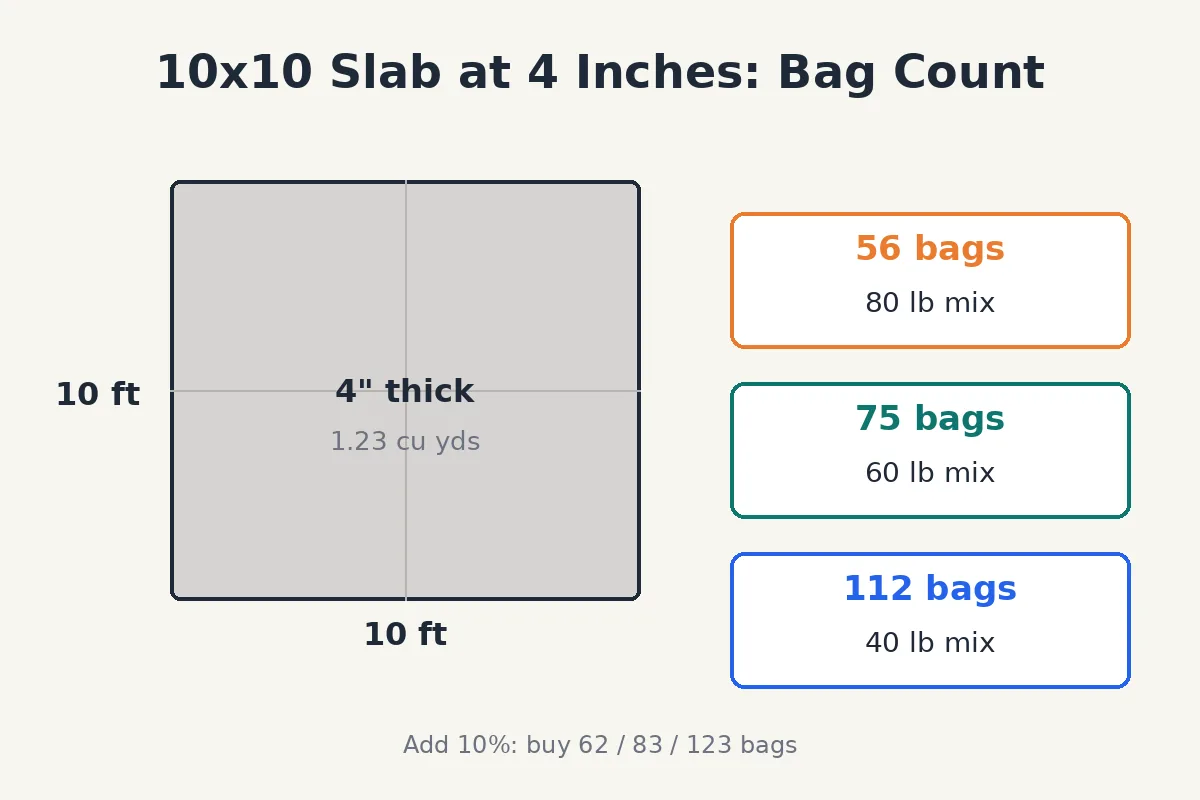
Wondering how many bags of concrete for a 10x10 slab? At the standard 4-inch depth, the answer is 56 bags of 80 lb concrete mix, and you should buy 62 to cover waste and uneven ground. That is the whole answer for most patios and shed pads. The charts below give you the exact count at every common depth, plus quick answers for the other slab sizes people search for most.
This is the quick-answer page. If you want the full installation walkthrough, subbase depths, and mixing ratios, read our deep slab bag guide.
How Many Bags of Concrete for a 10x10 Slab: Exact Chart by Depth
Volume math first, so you can sanity-check any number on this page: 10 ft x 10 ft x 0.333 ft (4 inches) = 33.33 cubic feet, which is 1.23 cubic yards. Bag yields are 0.60 cu ft (80 lb), 0.45 cu ft (60 lb), and 0.30 cu ft (40 lb).
| Slab Depth | Volume (cu yds) | 80 lb Bags | 60 lb Bags | 40 lb Bags | Buy With 10% Waste (80 lb) |
|---|---|---|---|---|---|
| 3 inches (walkway, shed) | 0.93 | 42 | 56 | 84 | 46 |
| 4 inches (standard patio) | 1.23 | 56 | 75 | 112 | 62 |
| 5 inches (hot tub, heavy use) | 1.54 | 70 | 93 | 139 | 77 |
| 6 inches (driveway, vehicles) | 1.85 | 84 | 111 | 167 | 92 |
💡 The 10% Rule: Subgrades are never perfectly flat and forms flex under liquid concrete. Multiply any bag count on this page by 1.10 and round up. Running short mid-pour creates a cold joint; a few leftover bags keep.
Popular Slab Sizes at 4 Inches: 8x8 Through 20x20
Same 4-inch depth, more sizes. Bag counts below are exact (no waste); add 10% when you buy.
| Slab Size | Volume (cu yds) | 80 lb Bags | 60 lb Bags | 40 lb Bags | Dry Weight (80 lb bags) |
|---|---|---|---|---|---|
| 8x8 (small pad) | 0.79 | 36 | 48 | 72 | 2,880 lb |
| 10x10 (patio) | 1.23 | 56 | 75 | 112 | 4,480 lb |
| 10x12 (patio) | 1.48 | 67 | 89 | 134 | 5,360 lb |
| 12x12 (large patio) | 1.78 | 80 | 107 | 160 | 6,400 lb |
| 16x16 (garage apron) | 3.16 | 143 | 190 | 285 | 11,440 lb |
| 20x20 (two-car pad) | 4.94 | 223 | 297 | 445 | 17,840 lb |
Two things jump out of this table. First, a 12x12 slab needs 80 bags, which is two full pallet loads and a full day with a mixer. Second, the 16x16 and 20x20 rows cross 3 cubic yards, which is where a ready-mix truck becomes cheaper than bags. If your slab is 16x16 or bigger, read our bags vs ready-mix decision guide before you buy a single bag.
How to Use These Charts in 60 Seconds
- Find your slab size in the table above and read across to your bag weight.
- Add 10% and round up. That is your buy quantity.
- Check the depth row if your slab is not 4 inches; every extra inch adds about 25% more concrete.
- Sanity-check the weight column. If the dry weight tops 7,000 lb (about 2 yards), price a ready-mix delivery, your back will thank you.
For anything not on these charts, odd sizes, round pads, or footings, our concrete calculator does the same math instantly for any dimensions.
What About Odd Shapes and Round Pads?
Not every slab is a neat rectangle. For L-shaped patios, break the shape into rectangles, look up each one, and add the bag counts together. For a round pad the math changes: a 10-foot-diameter circle at 4 inches holds about 26 cubic feet, which works out to 44 bags of 80 lb mix (49 with waste), noticeably less than the 56 bags a square 10x10 needs. Anyone comparing how many bags of concrete for a 10x10 slab against a round alternative should remember that corners add concrete. For any shape that is not on these charts, our concrete calculator handles rectangles, circles, and footings in one place.
Frequently Asked Questions
How many 80 lb bags of concrete do I need for a 10x10 slab at 4 inches?
56 bags exactly, and 62 with the standard 10% waste allowance. The slab holds 1.23 cubic yards, and each 80 lb bag yields 0.60 cubic feet.
How thick should a 10x10 concrete patio slab be?
Four inches is the standard for patios, walkways, and shed pads. Go 5 to 6 inches if the slab will carry a hot tub, a vehicle, or heavy equipment.
How much does the concrete weigh for a 10x10 slab?
The 56 dry bags weigh 4,480 lb (2.24 tons) before water. Cured concrete for the full 1.23-yard slab weighs close to 5,000 lb. Plan your hauling accordingly; that is three to four trips in a half-ton pickup.
Can I pour a 10x10 slab with bags in one day?
Yes, with a rented electric mixer and one helper. Fifty-six bags is a full but doable day: roughly 4 to 6 hours of mixing and placing plus setup and finishing. Start early, keep batches coming steadily, and never let the leading edge stiffen.
Should I order ready-mix instead of bags for a 10x10 slab?
At 1.23 cubic yards, bags are usually cheaper than a truck once the short-load fee is added. But if you value your weekend, a 1.5-yard delivery with a short-load fee often lands within $50 to $100 of the bag price. Price both before you decide.
Not a 10x10? Get Your Exact Count
Slab sizes vary and these charts cover the popular ones. Enter your exact length, width, and depth in our free Concrete Calculator for instant cubic yards and bag counts in 80 lb, 60 lb, and 40 lb sizes.
Ready to Calculate Your Project?
Enter your exact project dimensions into our verified calculator to get cubic yards, tons, and bags needed.
Open Material Calculator →More in Masonry Guides
View All Guides →Bags vs Ready-Mix Concrete: When to Order a Truck
Bags vs ready mix concrete cost comparison for slabs and footings. Break-even charts, short-load fees, and the exact yardage where a truck wins.
Cement vs Concrete: What's the Actual Difference?
Cement vs concrete explained by an engineer: cement is the binder, concrete is the finished mix. Learn the 1-2-3 ratio, bag labels, and when the terms matter.
Standard Cinder Block Dimensions, Weight & Pallet Counts
Master standard CMU sizes, actual weights, and pallet quantities with our expert civil engineering guide to concrete block measurements and ASTM standards.