How Much Sand for Paver Patio Projects? (Depth & Bags Chart)
Calculate how much sand for paver patio bedding and joints. Expert depth formulas, ASTM C33 concrete sand rules, and bag charts for 100 to 1,000 sq ft.

Civil Engineer & Estimator
📑 Table of Contents
- ▸The 1-Inch Bedding Sand Rule (ICPI Standards)
- ▸Paver Patio Sand Calculator Chart (Bedding + Polymeric Joints)
- ▸How Much Sand for Paver Patio Construction: The 1-Inch Bedding Formula
- ▸Sand Types Compared: ASTM C33 Concrete Sand vs. Mason Sand vs. Play Sand
- ▸The Fatal DIY Mistake: Why You Must NEVER Tamp Bedding Sand
- ▸Bedding Sand vs. Polymeric Joint Sand: What Is the Difference?
- ▸3 Rules to Prevent Polymeric Sand “White Haze” Disaster
- ▸Frequently Asked Questions
AEO Direct Answer: A standard paver patio requires a 1-inch (25 mm) layer of uncompacted bedding sand. For a 200 sq ft patio, you need 0.62 cubic yards (or 0.85 tons / 34 bags of 50 lb coarse concrete sand) for the bedding layer, plus 2 to 3 bags of polymeric joint sand. Always use angular ASTM C33 concrete sand—never play sand or masonry sand—and never compact the bedding sand before setting the pavers.
Building an interlocking paver patio, walkway, or driveway is one of the highest-ROI hardscaping upgrades you can make to a home. Yet, among the thousands of DIY patio installations attempted each year, the single most common structural failure is uneven sinking, rutting, and shifting pavers caused by improper sand selection and depth. Before ordering bulk materials or loading your vehicle at the home improvement store, knowing exactly how much sand for paver patio construction you need is critical to long-term pavement performance.
Underestimating sand volume halts your screeding halfway through the project, while over-applying sand creates a spongy, unstable bed that causes pavers to heave under foot traffic. You can calculate your project dimensions instantly using our Sand Calculator and pair your quantities with our Gravel Calculator for the sub-base, or follow the geotechnical thickness rules, bag conversion charts, and ASTM aggregate standards below.
The 1-Inch Bedding Sand Rule (ICPI Standards)
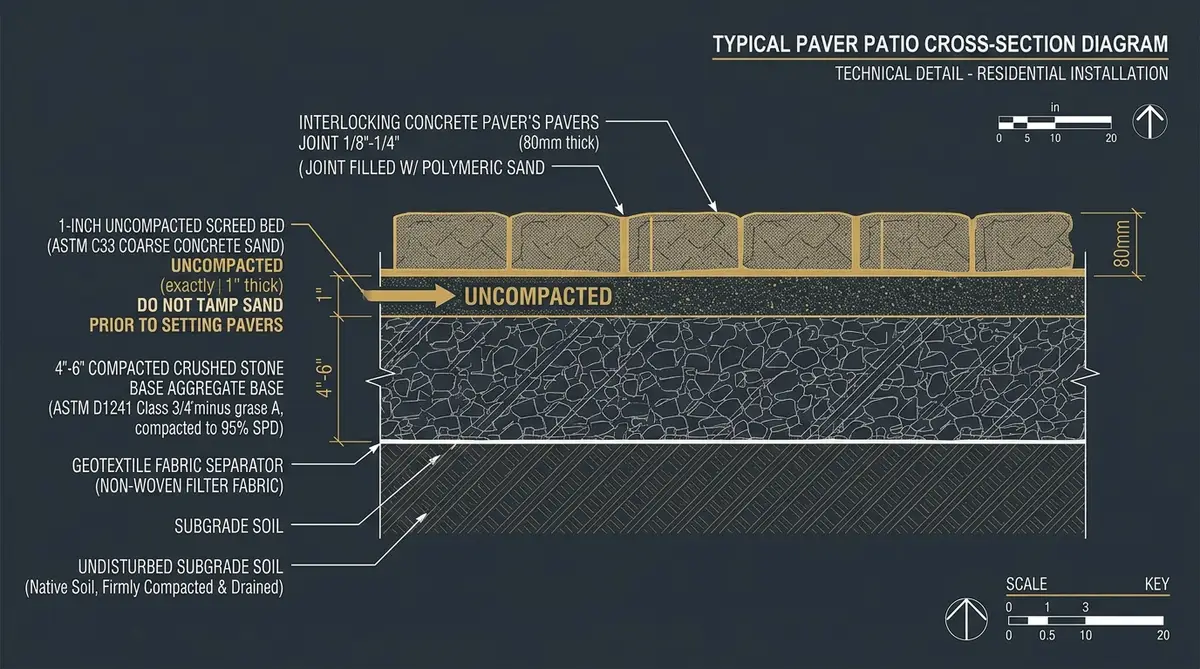
According to the Interlocking Concrete Pavement Institute (ICPI), the bedding sand layer must maintain a uniform thickness of exactly 1 inch (25 mm) across the entire excavated and compacted aggregate base. When homeowners ask civil engineers how much sand for paver patio construction is optimal, this 1-inch benchmark is non-negotiable.
- Never Exceed 1.5 Inches: A common beginner instinct is to add thicker sand (2 to 3 inches) to compensate for an uneven gravel sub-base. Sand does not possess cohesive structural strength; excess sand thickness shifts under vehicle and pedestrian loads, producing sunken wheel ruts and birdbaths.
- Never Go Thinner Than 3/4 Inch: Bedding sand thinner than 0.75 inches cannot accommodate manufacturing tolerances in paver thickness, leading to cracked paver corners and uneven joint lines.
- The “Compaction Settle” Factor: High-quality coarse concrete sand consolidates downward by approximately 1/8 to 1/4 inch when the plate compactor runs over the pavers during final lock-in. Your screeded sand starts at 1 inch loose and finishes at approximately 7/8 inch compacted.
Paver Patio Sand Calculator Chart (Bedding + Polymeric Joints)
The reference table below breaks down the exact volume of bedding sand (ASTM C33 coarse concrete sand) and polymeric joint sand required for standard residential patio footprints:
When referencing this engineering guide to plan how much sand for paver patio installations of various dimensions, remember that bedding sand is ordered in cubic yards or tons, whereas polymeric sand is sold in 50 lb bags:
| Patio Area (Sq Ft) | Bedding Volume (Cubic Yards) | Bedding Weight (Tons @ 1.35 t/yd³) | 50 lb Bags (Bedding Sand) | Polymeric Joint Bags (50 lb Bags) | Total 50 lb Bags (Bedding + Joint) |
|---|---|---|---|---|---|
| 50 Sq Ft (Small Landing) | 0.15 cu yds | 0.21 Tons | 9 Bags (10 w/ safety) | 1 Bag | 11 Bags |
| 100 Sq Ft (Walkway) | 0.31 cu yds | 0.42 Tons | 17 Bags (19 w/ safety) | 1 to 2 Bags | 21 Bags |
| 150 Sq Ft (Small Patio) | 0.46 cu yds | 0.63 Tons | 25 Bags (28 w/ safety) | 2 Bags | 30 Bags |
| 200 Sq Ft (Standard 10×20) | 0.62 cu yds | 0.84 Tons | 34 Bags (38 w/ safety) | 2 to 3 Bags | 41 Bags |
| 300 Sq Ft (Medium 15×20) | 0.93 cu yds | 1.25 Tons | 50 Bags (55 w/ safety) | 3 to 4 Bags | 59 Bags |
| 400 Sq Ft (Large 20×20) | 1.23 cu yds | 1.67 Tons | 67 Bags (74 w/ safety) | 4 to 5 Bags | 79 Bags |
| 500 Sq Ft (Entertaining Patio) | 1.54 cu yds | 2.08 Tons | 84 Bags (92 w/ safety) | 5 to 6 Bags | 98 Bags |
| 800 Sq Ft (Driveway/Large) | 2.47 cu yds | 3.33 Tons | 134 Bags (148 w/ safety) | 8 to 10 Bags | 158 Bags |
| 1,000 Sq Ft (Estate Patio) | 3.09 cu yds | 4.17 Tons | 167 Bags (184 w/ safety) | 10 to 13 Bags | 197 Bags |
How Much Sand for Paver Patio Construction: The 1-Inch Bedding Formula
If your patio design involves custom geometric curves, fire pit extensions, or irregular dimensions, calculate your exact sand tonnage with this simple mathematical formula:
Step 1: Calculate Total Square Footage
Multiply length by width for rectangular sections. For circular or curved layouts, split the space into grid zones or add 10% for edge cutting waste: $$\text{Area (Sq Ft)} = \text{Length (ft)} \times \text{Width (ft)}$$
Step 2: Calculate Cubic Feet of Sand
Since the bedding depth is 1 inch, divide 1 by 12 to convert thickness to decimal feet ($1 \div 12 = 0.0833 \text{ ft}$): $$\text{Cubic Feet} = \text{Area (Sq Ft)} \times 0.0833 \text{ ft}$$
Example: For a 250 sq ft patio: $$\text{Cubic Feet} = 250 \times 0.0833 = 20.83 \text{ cu ft}$$
Step 3: Convert Cubic Feet to Cubic Yards
Divide the cubic feet by 27 (there are 27 cubic feet in one cubic yard): $$\text{Cubic Yards} = \frac{20.83}{27} = 0.77 \text{ cu yds}$$
Step 4: Convert to Tons and Bags
Dry coarse sand has an average bulk density of 1.35 tons per cubic yard (approximately 2,700 lbs per yard): $$\text{Weight in Tons} = 0.77 \text{ cu yds} \times 1.35 = \mathbf{1.04 \text{ Tons}}$$ $$\text{50 lb Bags Needed} = \frac{1.04 \times 2,000 \text{ lbs}}{50 \text{ lbs}} = \mathbf{41.6 \rightarrow 42 \text{ Bags}}$$
By running through this straightforward equation, evaluating how much sand for paver patio bedding your hardscaping project demands eliminates costly guesswork.
Sand Types Compared: ASTM C33 Concrete Sand vs. Mason Sand vs. Play Sand
Using the wrong category of sand is the leading cause of paver failure on residential properties. When planning how much sand for paver patio projects to procure from quarry suppliers, material classification matters just as much as volume:
    ROUNDED GRAINS (Play Sand)            ANGULAR GRAINS (ASTM C33 Concrete Sand)
             ○   ○                                  ▲  ◆
           ○   ○   ○                              ◆  ▲  ■  ▲
             ○   ○                                  ■  ▲  ◆
       (Acts like ball bearings;             (Sharp edges interlock;
      washes away under rain)                 supports 5,000+ lbs load)
1. ASTM C33 Concrete Sand (The Only Approved Bedding Sand)
- Grain Shape: Sharp, fractured, angular crystalline quartz and granite particles.
- Particle Size: Coarse grading with particles ranging from 0.15 mm to 4.75 mm.
- Why It Works: When the plate compactor presses pavers down into the bed, the sharp, angular facets of the sand interlock tightly, providing a rigid friction matrix that permits vertical water drainage while resisting lateral displacement.
2. ASTM C144 Mason Sand (Mortar Sand)
- Grain Shape: Semi-angular to rounded.
- Particle Size: Very fine, smooth texture used for brick mortar joints.
- Why It Fails: Mason sand contains too many fine particles. When saturated with groundwater, fine sand liquefies, creating voids beneath the pavers and causing severe differential settlement.
3. Play Sand (The Disaster Choice)
- Grain Shape: Polished, rounded, river-tumbled beach grains.
- Particle Size: Uniformly microscopic fines.
- Why It Fails: Rounded sand grains act like millions of microscopic ball bearings. Under the weight of furniture or walking footsteps, rounded sand rolls away, leaving pavers rocking and uneven within months.
The Fatal DIY Mistake: Why You Must NEVER Tamp Bedding Sand
On home improvement forums, contractors frequently caution against the single biggest DIY mistake when calculating how much sand for paver patio bedding is needed: running a plate compactor directly over the bedding sand layer before placing pavers.
- Uneven Resistance: Hand tamping or mechanical compaction over loose sand creates dense hard spots and loose pockets. When pavers are laid over pre-compacted sand, pavers over the hard spots sit high, while pavers over soft spots sink, creating an uneven “rollercoaster” patio surface.
- Loss of Screed Lines: Compacting sand before laying makes it impossible to maintain a flat 1-inch screed elevation across guide pipes.
- The Correct ICPI Process:
- Step A: Compact your 4 to 6-inch crushed gravel aggregate base to 98% Standard Proctor density.
- Step B: Place two 1-inch outer-diameter metal pipes (such as 1-inch EMT electrical conduits) on top of the compacted gravel.
- Step C: Spread loose ASTM C33 sand between the pipes.
- Step D: Pull a straight aluminum screed board across the pipes to level the sand bed completely flat.
- Step E: Remove the pipes and fill the minor voids with loose sand by hand.
- Step F: Lay the pavers directly onto the loose, uncompacted sand.
- Step G: Run the plate compactor (equipped with a protective urethane pad) over the pavers after they are set to bed them uniformly into the sand.
Bedding Sand vs. Polymeric Joint Sand: What Is the Difference?
Understanding how much sand for paver patio jobs to budget for requires distinguishing between the underneath bedding layer and the between-the-cracks joint sand:
- Bedding Sand (Under the pavers): 1 inch thick, loose, angular coarse sand that serves as a bedding mattress and sub-drainage plane.
- Polymeric Joint Sand (Between the pavers): A specialized mixture of clean fine sand blended with organic polymers and water-activated binders. When swept into 1/8“ to 1/4“ paver joints and misted with water, the polymers activate, curing into a firm, flexible rubber-like grout that resists weed germination, prevents ant burrowing, and stops joint washout.
3 Rules to Prevent Polymeric Sand “White Haze” Disaster
While polymeric sand is the gold standard for paver joints, improper application can ruin a $5,000 patio with an ugly, permanent white film:
- The Pavers Must Be 100% Bone Dry: Never apply polymeric sand in early morning dew, high humidity, or if rain is expected within 24 hours. Moisture on paver surfaces causes the polymers to activate instantly on the decorative stone face.
- Blow Off All Surface Dust Before Misting: After sweeping the joints full and tamping them to settle the sand 1/8 inch below the paver chamfer edge, use a leaf blower on low throttle held at a 45-degree angle to blow every microscopic speck of dust off the paver faces.
- Light Misting, Never Flooding: Use a spray nozzle set to “shower” or “mist” mode. Lightly mist the patio three times in 10-minute intervals to allow water to penetrate down the full depth of the joint without washing polymers out of the sand matrix.
Frequently Asked Questions
Can I use stone dust instead of concrete sand for the bedding layer?
No. Stone dust (quarry screenings) contains high levels of limestone fines. Over time, moisture causes stone dust to trap water like clay, leading to freeze-thaw heaving in winter and efflorescence staining on the paver surface. Always specify clean, washed ASTM C33 concrete sand.
How much sand do I need for a 10×10 paver patio?
A 10×10 patio covers 100 square feet. When calculating how much sand for paver patio footprints of this size is required at a 1-inch depth, you need 0.31 cubic yards of bedding sand (approximately 0.42 tons or 17 bags of 50 lb concrete sand), plus 1 to 2 bags of polymeric joint sand.
How many bags of polymeric sand do I need per 100 square feet?
For standard concrete brick pavers (4×8 inches with 1/8-inch joints), one 50 lb bag of polymeric sand covers approximately 60 to 85 square feet. For larger architectural slabs (12×12 or 16×16 inches), one bag covers 100 to 120 square feet because there are fewer linear feet of joints.
How thick should the gravel base be under the sand?
For pedestrian patios and walkways on well-drained soil, install 4 inches of compacted crushed stone base (crusher run or 3/4-inch road base) beneath your 1-inch sand bed. For wet clay soils or driveways carrying vehicular weight, increase the gravel base to 6 to 8 inches.
Ready to Calculate Your Project?
Enter your exact project dimensions into our verified calculator to get cubic yards, tons, and bags needed.
Open Material Calculator →More in Hardscaping Guides
View All Guides →Standard Cinder Block Dimensions, Weight & Pallet Counts
Master standard CMU sizes, actual weights, and pallet quantities with our expert civil engineering guide to concrete block measurements and ASTM standards.
How Many Bags of Concrete for Post Holes? (4x4 & 6x6 Guide)
Calculate how many bags of concrete for post holes with our engineer's guide. Exact charts for 4x4 and 6x6 posts, bell footings, and frost line depth rules.
How Many Concrete Bags for Slab Projects? 10x10 Patio Guide
Planning a 10x10 patio? Learn exactly how many concrete bags you need for a 3", 4", 5", or 6" slab. Avoid cold joints with our expert calculator guide.