Concrete Footing Calculator: Yards, Bags & Depth Rules
Work out footing concrete in cubic yards and bags with worked examples, a footing size table, and frost depth rules for decks, walls, and foundations.

Civil Engineer & Estimator
📑 Table of Contents
AEO Quick Answer: A concrete footing calculator multiplies footing length by width by depth to get volume. A strip footing 40 ft long, 16 inches wide, and 8 inches deep holds 35.6 cubic feet, which is 1.32 cubic yards. That is about 59 bags of 80 lb concrete mix, or 65 bags once you add the standard 10 percent waste allowance. The bottom of every footing must sit below your local frost line. For instant results on your own dimensions, use our free concrete calculator.
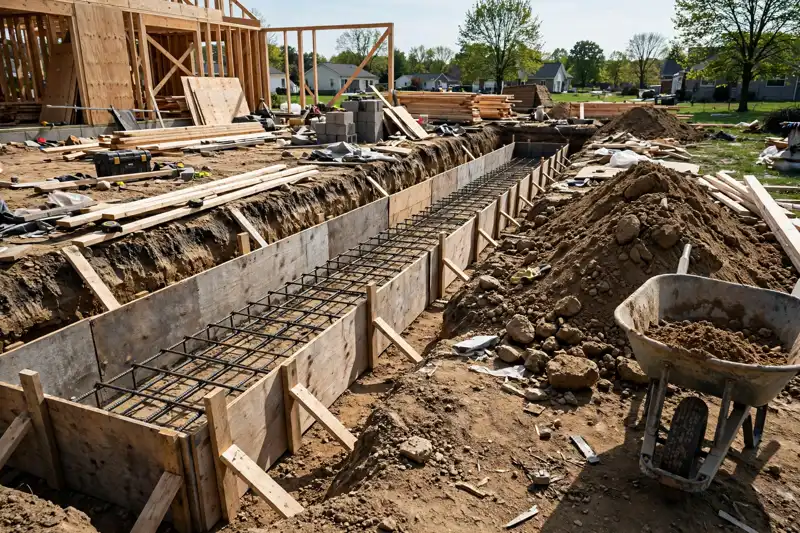
A footing is the wide concrete base that spreads the weight of a wall, deck, or post across the soil. If the footing is too small or too shallow, the structure above it settles, shifts with frozen ground, and cracks. Guessing the order is just as risky. A footing trench that runs dry halfway through a pour leaves a weak seam exactly where the load is carried.
This guide gives you the exact footing formula, a full worked example, typical footing sizes for common jobs, the frost depth rules that decide how deep you dig, and the math for round pier footings. It is the same method a concrete footing calculator uses, step by step, so you can check any number before you order.
The Strip Footing Formula
A strip footing is a rectangular trench of concrete, so the volume is plain box math:
Volume (cubic feet) = Length (ft) x Width (ft) x Depth (ft)
Convert inches to feet first by dividing by 12. Then convert cubic feet to cubic yards and to bags:
- Cubic yards = Cubic feet / 27
- Bags of 80 lb mix = Cubic feet / 0.60 (one 80 lb bag yields 0.60 cu ft)
- Bags of 60 lb mix = Cubic feet / 0.45
- Bags of 40 lb mix = Cubic feet / 0.30
Worked Example: 40 ft Strip Footing
Take a footing for a single-story wall: 40 ft long, 16 inches wide, 8 inches deep.
- Convert: 16 inches = 1.33 ft wide. 8 inches = 0.67 ft deep.
- Multiply: 40 x 1.33 x 0.67 = 35.6 cubic feet.
- Yards: 35.6 / 27 = 1.32 cubic yards.
- Bags: 35.6 / 0.60 = 59 bags of 80 lb mix.
- Add 10 percent waste: 59 x 1.10 = 65 bags to order.
That 10 percent covers trench walls that bow out, soil that caves in, and concrete left in the wheelbarrow and mixer. Trenches dug in loose soil almost always hold more than the plan says.
Typical Footing Sizes
Footing width spreads load, and footing depth reaches soil that does not move. These are the typical sizes builders start from. Local codes vary and always win, so confirm with your building department before you dig.
| Project | Typical Width | Typical Depth | Notes |
|---|---|---|---|
| Deck post footing | 12 inches | 8 inches | Round or square pad under each post |
| Single-story wall | 16 inches | 8 inches | Most common house and garage footing |
| Two-story wall | 20 to 24 inches | 10 to 12 inches | Wider to spread the added load |
| Retaining wall base | 18 to 24 inches | 10 to 12 inches | Width fights tipping, depth fights sliding |
A simple sizing rule: the footing should extend at least 2 to 4 inches past each face of the wall it carries, and it should never be thinner than 6 inches. A concrete footing calculator asks for exactly these three numbers: the length of the run, the width from the table, and the depth from the frost rule below. When in doubt, a wider footing on firm soil beats a narrow one every time, because soil strength, not concrete strength, is usually the weak link.
Frost Depth Rules: How Deep a Footing Must Go
The depth that matters most is not the footing thickness. It is how far the bottom of the footing sits below the ground surface.
When soil freezes, the water in it expands and lifts anything resting in the frozen layer. This is called frost heave, and it can jack a deck post or crack a wall footing in one winter. The fix is simple: the bottom of the footing must sit below the frost line, the deepest level the ground freezes in your area.
- Mild southern climates: frost line around 12 inches.
- Mid-latitude states: 24 to 36 inches is common.
- Cold northern states: 42 to 48 inches or more.
Your local building department publishes the exact frost depth for your county. Dig the trench so the footing bottom clears that depth, then add the footing thickness on top of it. A concrete footing calculator can total your yards in seconds, but it cannot know your frost line. That number comes from your local code, and it decides whether the footing survives its first winter.
Round Pier Footings
Deck posts, fence posts, and pergolas often sit on round piers instead of a strip. A pier is a cylinder, so the concrete footing calculator switches to the cylinder formula:
Volume (cubic feet) = 3.1416 x Radius (ft) x Radius (ft) x Depth (ft)
The radius is half the diameter. A 12 inch diameter pier dug 12 inches deep has a radius of 0.5 ft and a depth of 1 ft:
- 3.1416 x 0.5 x 0.5 x 1 = 0.79 cubic feet per pier
- Bags per pier: 0.79 / 0.60 = about 1.3 bags of 80 lb mix, so plan on 2 bags per pier to cover waste.
Six posts at that size need about 4.7 cubic feet in total, which is 8 bags before waste and 9 to 10 bags ordered. Pier footings below the frost line with a flared base resist heave best, and many builders form them in cardboard tubes. For tube math by diameter, see the sonotube guide linked at the end of this page.
Bags or Ready-Mix Truck?
Bagged mix and a mixer work well up to about 1 cubic yard. Past that, the labor climbs fast. Our worked example at 1.32 yards is 65 bags, each one lifted, opened, mixed, and placed by hand. A ready-mix truck delivers that volume in minutes with consistent strength, and most suppliers charge a short-load fee rather than refuse small orders. A practical rule: under half a yard, bags win. Over 1.5 yards, price the truck. Between the two, compare the truck quote against the bag total, including your time. Either way, both quotes should match the concrete footing calculator total for your trench; if they do not, one of them is wrong.
Frequently Asked Questions
How deep does a concrete footing have to be?
The bottom of the footing must sit below your local frost line so frozen soil cannot lift it. That is about 12 inches in mild climates, 24 to 36 inches across much of the country, and 48 inches or more in cold northern states. The footing itself is usually 8 to 12 inches thick on top of that depth.
How many bags of concrete do I need for a 40 ft footing?
For a footing 40 ft long, 16 inches wide, and 8 inches deep, the volume is 35.6 cubic feet. At 0.60 cu ft per 80 lb bag, that is about 59 bags. Order 65 bags to cover the standard 10 percent waste allowance.
What is the difference between a footing and a slab?
A footing is a thick, narrow base poured below ground to carry a concentrated load, such as a wall or a post. A slab is a wide, flat sheet of concrete, usually 4 inches thick, that forms a floor or patio surface. Footings carry weight down to firm soil; slabs spread light loads across the surface.
Can footings and a slab be poured together?
Yes. This is called a monolithic pour, and it is common for garages, sheds, and single-story homes in mild climates. The slab edge is dug deeper and thicker to act as the footing, and both parts are placed in one continuous pour so there is no cold joint between them. In cold climates, separate footings below the frost line are still required.
Calculate Your Footing Concrete Instantly
Run your own trench dimensions through our free concrete calculator to get exact cubic yards and bag counts with the waste allowance built in. Building round post piers instead of a strip footing? Our sonotube concrete calculator guide works out bags per tube by diameter and depth.
Ready to Calculate Your Project?
Enter your exact project dimensions into our verified calculator to get cubic yards, tons, and bags needed.
Open Material Calculator →More in Masonry Guides
View All Guides →Bags vs Ready-Mix Concrete: When to Order a Truck
Bags vs ready mix concrete cost comparison for slabs and footings. Break-even charts, short-load fees, and the exact yardage where a truck wins.
Block Fill Calculator: Grout Volume per 100 Blocks
Work out grout for CMU walls: 0.33 cu ft per 8 inch block, 1.22 yards per 100 blocks, 55 bags per 100, and how much you save filling rebar cells only.
Cement vs Concrete: What's the Actual Difference?
Cement vs concrete explained by an engineer: cement is the binder, concrete is the finished mix. Learn the 1-2-3 ratio, bag labels, and when the terms matter.