Calcula tu Proyecto
Carpet Needed
—sq yd
Ingresa las dimensiones arriba
Padding Needed
—sq yd
Includes 10% waste - padding matches carpet
Enter your room size and the carpet calculator converts square feet to square yards, adds 10% waste, and plans your seams and padding.
Carpet Needed
Ingresa las dimensiones arriba
Padding Needed
Includes 10% waste - padding matches carpet
| 10x12 bedroom | 14.7 sq yd, no seams |
| 12x12 bedroom | 17.6 sq yd, no seams |
| 15x20 living room | 36.7 sq yd, 1 seam |
| 20x20 great room | 48.9 sq yd, 1 seam |
| Budget polyester carpet | $15 - $25 |
| Mid-range nylon carpet | $25 - $45 |
| Premium wool or patterned | $45 - $90 |
| New padding (7/16 in, 8-lb) | $4 - $8 |
Prices are 2026 US averages. Actual costs vary by region and supplier.
| Proyecto / Uso | Profundidad Recomendada |
|---|---|
| Standard carpet roll width | 12 ft (most residential) |
| Wide roll (fewer seams) | 15 ft |
| Waste allowance | 10% (closets, cuts, pattern match) |
| Standard padding | 7/16 in thick, 8-lb density |
La mayoría de los proveedores venden carpet por yarda cúbica. Para convertir el área a yardas cúbicas, usa esta fórmula:
Nuestra calculadora también multiplica el resultado por 0 toneladas/yd³ (la densidad estándar de carpet) para mostrar el peso estimado.
A carpet calculator converts your room dimensions into square yards, because carpet is manufactured, priced, and sold by the square yard rather than the square foot. The formula is (Length x Width) / 9, plus a 10% waste allowance for cuts, closets, and pattern matching. A 12x12 room is 144 square feet, which divides to 16 square yards, and the waste factor brings the order to 17.6 square yards. Skip the waste allowance and you discover the shortage only after the installer has cut the final piece, when a second dye lot is your only option. Getting the square-yard number right is the entire job: every price quote, seam plan, and padding order flows from it.
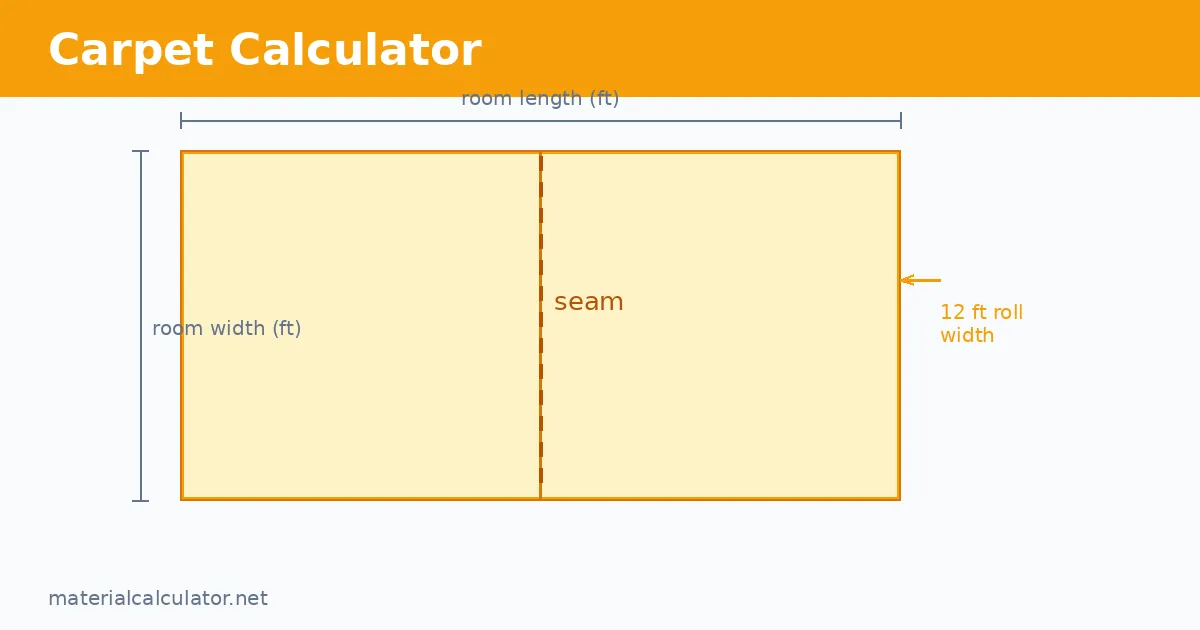
Roll width controls seams and linear footage. Residential carpet comes 12 feet wide, with 15-foot rolls available for wide rooms. Your room is covered by laying strips side by side, and the strip count is the room width divided by the roll width, rounded up: a 12-foot-wide room needs one strip and zero seams, while a 15-foot-wide room needs two strips and one seam. Linear feet to buy equals (Square Yards x 9) / Roll Width, so that 17.6 square yards for the 12x12 room needs 13.2 linear feet off a 12-foot roll. When a room is just over 12 feet wide, ask about 15-foot rolls before accepting a seam: the wider roll often costs less than the extra material and labor a seam consumes.
Seam placement separates professional installs from obvious ones. Every seam is a line where two carpet edges are heat-bonded with seam tape, and it stays slightly visible up close forever. The rules are simple: run seams perpendicular to the main window so light does not rake along the edge, keep them out of doorways and pivot points where foot traffic flexes them, and never seam the wear path in front of a sofa or desk. Patterned carpet adds a pattern-match requirement: the pattern must align across the seam, which consumes extra material and pushes waste to 15-20% instead of 10. A good installer diagrams seam placement before cutting a single strip, and you should approve that diagram: once carpet is cut, the seam locations are permanent.
Padding is ordered in the same square yards as the carpet, and it matters more than most buyers expect. The residential standard is 7/16-inch thick, 8-pound density rebond foam: thick enough to feel luxurious underfoot, dense enough to support the carpet backing for a decade or more. Thinner or lighter padding lets the carpet backing flex and crack with every step, which is the actual mechanism behind most premature carpet failure. Old padding is never reused under new carpet: it has compressed unevenly into the traffic lanes, it holds a decade of dust and odor, and reusing it voids nearly every manufacturer warranty. Budget $4 to $8 per square yard installed for quality padding; it is the cheapest longevity you can buy in the whole project. That is why a carpet calculator lists padding as its own line item instead of burying it in the total.
Measure like an installer before you run the numbers through a carpet calculator. Take the longest length and the widest width of each room, including closets, bays, and the full depth of doorways, because the roll is cut to your maximum dimensions in both directions. Stairs are measured separately: each tread plus riser counts as one unit, and a typical staircase needs 4 to 6 square yards on its own. Always keep a 3x3 foot remnant from the original dye lot after installation: future repairs for pet damage, burns, or bleach spots are invisible only when the patch comes from the identical lot. Between the waste factor, the seam plan, and the remnant, a careful carpet calculator order means the installer never waits on material and you never pay for a second dye lot.
Measure every room at its longest and widest points, including closets, alcoves, and doorways. Carpet is cut from the roll to your largest dimensions, and an alcove you forgot becomes an expensive seam or a second piece.
Run seams perpendicular to the main window or light source. Seams catch light along their edge, and placing them across the light instead of along it makes them nearly invisible.
Never put a seam in a doorway or a pivot point like the bottom of stairs. Foot traffic flexes seams, and a seam in a high-traffic spot will peak and split years before the carpet wears out.
Keep a remnant of at least 3x3 feet after installation. Future patch repairs for burns, pet damage, or bleach spots are invisible only when the patch comes from the original dye lot.