Calculez votre projet
Roofing Squares
—squares
Entrez les dimensions ci-dessus
Shingle Bundles
—bundles
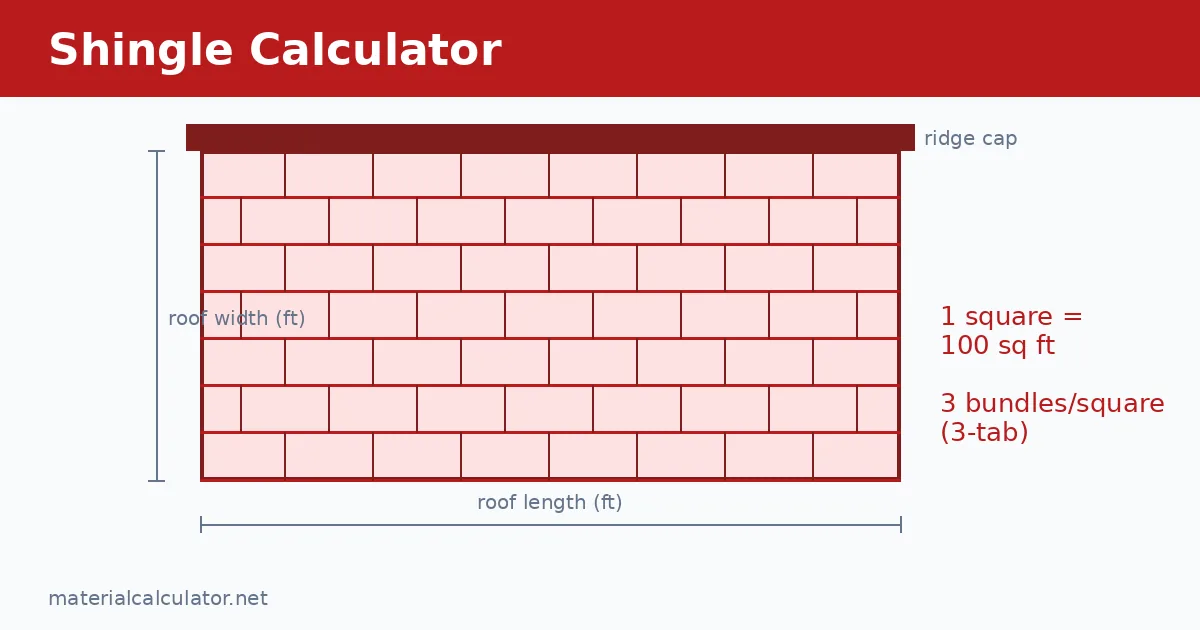
3-tab: 3 bundles/sq - architectural: 3.5/sq
Enter roof dimensions and the shingle calculator applies your pitch factor, then outputs squares, bundles, and underlayment rolls.
Roofing Squares
Entrez les dimensions ci-dessus
Shingle Bundles
3-tab: 3 bundles/sq - architectural: 3.5/sq
| 1,500 sq ft (15 squares) | 50 bundles + 4 felt rolls |
| 2,000 sq ft (20 squares) | 66 bundles + 5 felt rolls |
| 2,500 sq ft (25 squares) | 83 bundles + 7 felt rolls |
| 3,000 sq ft (30 squares) | 99 bundles + 8 felt rolls |
| 3-tab shingle bundle | $30 - $40 |
| Architectural shingle bundle | $35 - $55 |
| #15 felt underlayment roll | $25 - $40 |
| Professional install (per square) | $350 - $550 |
Prices are 2026 US averages. Actual costs vary by region and supplier.
| Projet / Utilisation | Profondeur recommandée |
|---|---|
| 1 roofing square equals | 100 sq ft of roof surface |
| 3-tab shingles | 3 bundles per square |
| Architectural shingles | 3 to 4 bundles per square |
| #15 felt underlayment roll | Covers 4 squares |
La plupart des fournisseurs vendent le shingle à la verge cube. Pour convertir la surface en verges cubes, utilisez cette formule :
Notre calculatrice multiplie également le résultat par 0 tonnes/vg³ (densité standard) pour estimer le poids.
A shingle calculator converts your roof footprint into orderable quantities: squares, bundles, and underlayment rolls. The chain is (Length x Width x Pitch Factor) / 100 = Squares, then Squares x 3 = Bundles for 3-tab shingles, plus 10% waste for cuts and starter strips. A 40x50 foot roof at a 6/12 pitch: 2,000 x 1.15 = 2,300 square feet = 23 squares = 69 bundles, plus waste = 76 bundles. Underlayment runs on a separate track: Squares / 4 = rolls of #15 felt. Ridge caps, starter strips, and flashing are counted separately from field shingles, so the bundle number from the calculator is your field-shingle order, not the whole roof.
The pitch factor corrects for the fact that a sloped roof has more surface than its flat footprint. It is the hypotenuse of the pitch triangle: for a 6/12 pitch, the square root of (1 + (6/12)^2) = 1.118. Rather than doing trigonometry on a ladder, use standard brackets: 3/12 to 4/12 multiplies by 1.02 to 1.05, 5/12 to 7/12 by 1.10 to 1.20, and 8/12 to 12/12 by 1.25 to 1.40. Measure pitch with a 2-foot level and a tape: hold the level horizontal against the roof, mark 12 inches out, and measure the vertical rise at that mark. That rise over 12 is your pitch, and the bracket it falls in sets your factor. Steep roofs also cost more in labor, so the factor affects the quote twice. This is also why a shingle calculator asks for pitch instead of making you measure true surface area with a tape on a slope.
Bundle counts depend on shingle type, and this is where estimates most often go wrong. The 3-bundles-per-square standard holds for 3-tab and most architectural shingles, but heavy designer profiles can pack 4 or even 5 bundles per square because each shingle is thicker and heavier. The bundle wrapper states the coverage and is the only authoritative source: trust it over any rule of thumb, including this one. Architectural shingles also weigh more per square (240-250 lbs versus about 200 for 3-tab), which matters for delivery logistics, for the crew carrying bundles up a ladder, and for older roof structures near their load limits. When comparing bids, confirm both quotes assume the same shingle profile, or the bundle counts will not be comparable.
Waste is driven by roof complexity, not just area. A simple gable roof wastes about 10%: ridge cuts, starter strips, and the occasional miscut. Hip roofs climb to 12-15% because every hip line demands angled cuts on both sides. Valleys, dormers, chimneys, and skylights each add cutting and step-flashing work that consumes material beyond the field count, so complex roofs should be estimated at 15% waste minimum. The leftover bundles are not really waste: they become your repair stock, and repairs from the original dye lot are invisible while a later lot never quite matches. Order the waste with the main delivery; buying three bundles two years later costs more per bundle and matches nothing.
Underlayment math deserves its own pass. Standard #15 felt covers 4 squares per roll with the required overlaps, so a 23-square roof needs 6 rolls; synthetic underlayment covers about 10 squares per roll, installs faster, and resists tearing if wind catches it mid-install. In cold climates, code requires self-adhering ice-and-water shield along the eaves extending 24 inches past the interior wall line: measure eave linear footage separately, since no area formula captures it. After running the roof through a shingle calculator, walk the roof and count every penetration (vents, pipes, skylights, chimney): each one needs flashing, a boot or cricket, and a little extra field material around it. None of that shows up in a shingle calculator output, so budget two to three extra bundles beyond the calculated waste for penetrations and ridge work. Add one bundle of ridge caps per 30-35 linear feet of ridge and hip, plus starter strip at one bundle per 100-120 linear feet of eave and rake.
Read the bundle wrapper before trusting any bundle-per-square number. Most architectural shingles pack 3 bundles per square, but heavy designer profiles pack 4 or 5, and the wrapper is the only authoritative source.
Order ridge cap shingles separately: they are not included in field bundle counts. A typical home needs 1 bundle of ridge caps per 30-35 linear feet of ridge and hip.
Do not install the calculated bundle count with zero margin. Shingle dye lots vary slightly, and a repair five years from now is invisible only with leftover bundles from the original lot.
Count starter strip shingles too: one bundle of starter covers about 100-120 linear feet of eave and rake. Skipping starters and flipping field shingles voids most manufacturer warranties.