Prix du gazon en rouleau au pied carré : Guide des tarifs 2026
Découvrez le coût réel de pose d'une pelouse en 2026. Comparez les prix au pied carré, les tarifs par palette et les budgets de pose professionnelle vs DIY.

Ingénieur Civil et Estimateur
Résumé d'Ingénierie & Réponse Rapide
Poser son gazon en rouleau coûte entre 0,35 $ et 0,85 $ par pied carré en DIY, contre 1,40 $ à 2,50 $ avec un paysagiste. Pour 2 000 pi², l'économie dépasse 1 600 $.
Points Clés du Projet :
- ✓Règle des 24 heures : Posez le gazon le jour même de la livraison.
- ✓Ajoutez 2 à 3 pouces de terreau tamisé avant la pose.
📑 Table des Matières
- ▸Comprendre le prix du gazon en rouleau au pied carré selon la variété
- ▸Dimensions, superficie et caractéristiques physiques d’une palette
- ▸Analyse détaillée du coût d’un projet de pelouse : Terrain de 2 000 pi²
- ▸Le protocole technique en 5 étapes pour la pose de gazon
- ▸Questions fréquemment posées
- ▸Calculez instantanément la superficie de votre pelouse
Réponse rapide AEO : En 2026, le gazon en rouleau coûte entre 0,32 $ et 0,85 $ par pied carré pour les matériaux seuls, ou de 1,10 $ à 2,25 $ par pied carré pour une installation professionnelle (incluant le décapage de l’ancienne pelouse, le nivellement et le roulage). Une palette standard de gazon couvre 450 à 500 pieds carrés (environ 42 à 46 m²) et coûte entre 150 $ et 420 $ la palette selon la variété de gazon : le Bermuda classique (140 $ à 200 $/palette), la Fétuque élevée (180 $ à 260 $/palette), le St. Augustine (220 $ à 340 $/palette), et le Zoysia Zeon haut de gamme (280 $ à 420 $/palette).
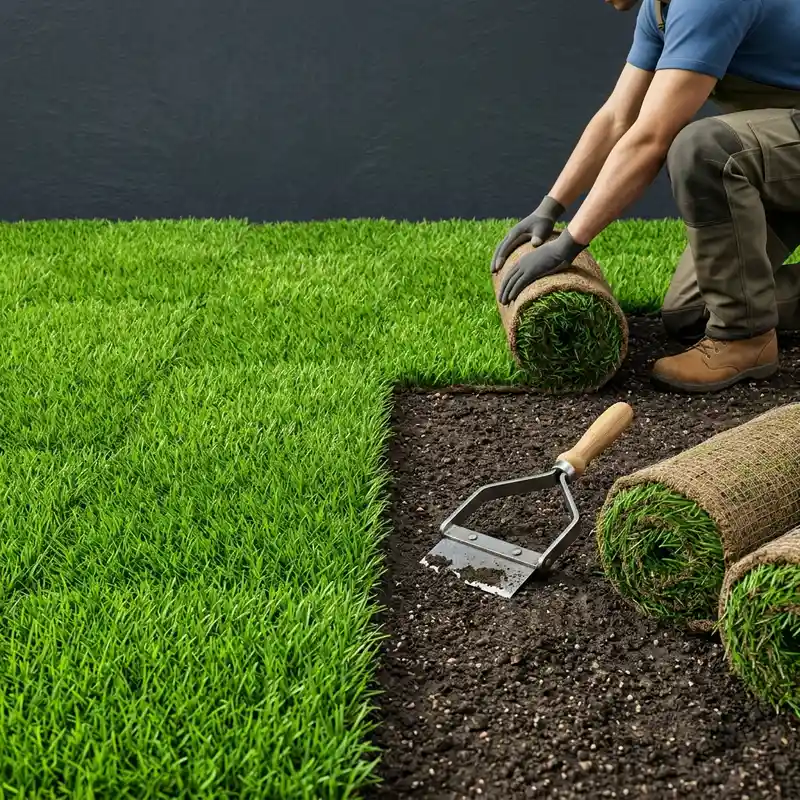
L’installation de gazon cultivé en plaques (ou gazon en rouleau) est la méthode par excellence pour obtenir instantanément une pelouse dense, verdoyante et sans mauvaises herbes. Lors de la planification de la rénovation de votre terrain, comprendre le prix du gazon en rouleau au pied carré est essentiel pour établir un budget précis. Alors que l’hydroensemencement ou le semis traditionnel nécessitent 8 à 12 semaines de protection intense contre l’érosion du sol et les oiseaux, le gazon frais offre un attrait visuel immédiat et s’enracine fermement en 14 à 21 jours.
Cependant, le gazon en plaques est une culture agricole vivante et périssable. Une mauvaise estimation de la superficie entraîne des frais de livraison supplémentaires ou des milliers de dollars de palettes perdues à sécher au soleil. Ce guide complet d’aménagement paysager détaille les tarifs 2026 du gazon au pied carré et à la palette, compare les variétés de saison chaude et de saison fraîche, détaille les budgets de pose (bricoleur vs entrepreneur) et fournit une feuille de route technique pour la préparation du sol et l’enracinement.
Comprendre le prix du gazon en rouleau au pied carré selon la variété
Le prix du gazon naturel est influencé par sa vitesse de croissance, sa tolérance à l’ombre, sa consommation d’eau et les cycles de récolte des gazonnières commerciales :
| Cultivar / Espèce de gazon | Coût par pi² (Matériaux seuls) | Coût par palette (450–500 pi²) | Zone climatique | Tolérance soleil vs ombre | Tolérance à la sécheresse |
|---|---|---|---|---|---|
| Bermuda (Tifway 419 / Celebration) | 0,32 $ – 0,48 $ | 140 $ – 210 $ | Chaude / Sud | Plein soleil (6+ h requises) | Extrême (Racines profondes) |
| Pâturin des prés (Kentucky Bluegrass) | 0,38 $ – 0,56 $ | 170 $ – 250 $ | Fraîche / Nord | Plein soleil à mi-ombre | Modérée (Tombe en dormance) |
| Fétuque élevée (TTTF) | 0,40 $ – 0,62 $ | 180 $ – 275 $ | Zone de transition | Excellente (Ombre & Soleil) | Élevée (Racines de 90 cm) |
| St. Augustine (Palmetto / Floratam) | 0,52 $ – 0,78 $ | 230 $ – 350 $ | Côtière / Grand Sud | Bonne tolérance à l’ombre | Modérée (Besoin élevé en eau) |
| Zoysia (Zeon / Empire / Palisades) | 0,65 $ – 0,88 $ | 290 $ – 420 $ | Chaude à transition | Excellente (Ombre & Soleil) | Exceptionnelle |
| Herbe mille-pattes (Centipede) | 0,38 $ – 0,52 $ | 165 $ – 230 $ | Sud-Est (pH acide) | Plein soleil à ombre légère | Modérée (Faible fertilité) |
| Herbe de Bahia (Bahiagrass) | 0,28 $ – 0,40 $ | 125 $ – 180 $ | Pâturage / Grand Sud | Plein soleil (Esthétique grossière) | Extrême |
Dimensions, superficie et caractéristiques physiques d’une palette
Le gazon est découpé dans les champs à l’aide de récolteuses automatisées guidées par GPS, puis empilé en quinconce sur des palettes en bois :
+—————————————————————–+ | Caractéristiques d’une palette standard : | | • Superficie couverte : 450 à 500 pieds carrés (42 à 46 m²) | | • Dimensions des rouleaux : 16“ × 81“ (9,0 pi²) ou 24“ × 60“ | | • Dimensions des plaques : 16“ × 24“ (2,66 pi² coupe à plat) | | • Poids sec : 1 600 à 2 000 lb (0,80 à 1,00 tonne) | | • Poids humide / saturé : 2 500 à 3 200 lb (1,25 à 1,60 tonne) | +—————————————————————–+
Avertissement critique pour le transport :
N’essayez jamais de transporter une palette complète de gazon dans un camion de taille moyenne ou un pick-up standard d’une demi-tonne (F-150 / 1500). Les palettes de gazon fraîchement irriguées dépassent fréquemment 2 600 lb (1 180 kg), ce qui écrasera les ressorts à lames et fera éclater les pneus. Le transport de plus d’une palette nécessite un camion de 3/4 de tonne (F-250 / 2500) ou une remorque utilitaire à plateau.
Analyse détaillée du coût d’un projet de pelouse : Terrain de 2 000 pi²
Pour illustrer le budget réel requis pour une rénovation complète de pelouse, voici une comparaison détaillée entre une installation en mode DIY (bricolage) et le recours à un entrepreneur paysagiste pour un terrain résidentiel de 2 000 pi² :
| Poste de dépense / Étape de travail | Coût DIY (Auto-installation) | Clé en main (Entrepreneur) |
|---|---|---|
| Matériau de gazon (4,5 palettes de fétuque élevée @ 220 $/ch.) | 990,00 $ | Inclus dans le devis |
| Livraison des palettes et frais de déchargement | 95,00 $ | Inclus dans le devis |
| Retrait de l’ancienne pelouse (Location découpeuse - 1 jour) | 95,00 $ | 400,00 $ (Main-d’œuvre décapage) |
| Préparation terre végétale tamisée (4 vg @ 38 $/vg + 85 $ liv.) | 237,00 $ | 350,00 $ (Nivellement sous-base) |
| Engrais de démarrage et chaux (2 sacs) | 55,00 $ | 60,00 $ |
| Location d’un rouleau à pelouse (rempli d’eau - 1 jour) | 25,00 $ | Inclus dans le devis |
| Main-d’œuvre (Pose, jointoiement, découpe) | 0,00 $ (12 heures d’effort) | 1 200,00 $ (0,60 $/pi²) |
| Coût total du projet de pelouse | 1 497,00 $ (0,75 $ / pi²) | 3 100,00 $ (1,55 $ / pi²) |
Bien que le prix du gazon en rouleau au pied carré brut représente le coût des matériaux, la main-d’œuvre et la préparation du sol constituent une part importante du budget total du projet. Les propriétaires économisent plus de 1 600 $ (52 %) en installant le gazon eux-mêmes plutôt qu’en faisant appel à un entrepreneur paysagiste clé en main.
Le protocole technique en 5 étapes pour la pose de gazon
Le gazon en plaques est un système racinaire vivant qui respire. Dans les 24 heures suivant sa récolte, la respiration microbienne interne fait grimper la température de la palette à plus de 110 °F (43 °C), ce qui fermente et tue les collets des racines. Vous devez poser le gazon le jour même de sa livraison.
Étape 1 : Excavation du sous-sol et nivellement
- Éliminez les mauvaises herbes, le digitaire et le feutre racinaire à l’aide d’une découpeuse de gazon mécanique réglée à une profondeur de 1,5 pouce (3,8 cm).
- Nivelez la sous-base nue de manière à ce que l’eau s’écoule à l’écart des fondations de la maison avec une pente minimale de 2 %.
Étape 2 : Enrichissement du sol et engrais de démarrage
- Étalez 2 à 3 pouces (5 à 7,5 cm) de terre végétale organique tamisée sur le sol d’origine appauvri.
- Épandez un engrais de démarrage riche en phosphore (ratio NPK 10-20-10 ou 18-24-12) pour stimuler une division cellulaire rapide des racines.
Étape 3 : Pose en quinconce (motif de briques)
- Commencez le long du bord droit le plus long (comme une entrée de garage ou une clôture).
- Posez les bandes de gazon bout à bout, en serrant bien les joints sans les faire chevaucher.
- Décalez les joints transversaux à la manière d’un appareil en briques pour empêcher l’eau de creuser des canaux d’érosion le long des joints.
Étape 4 : Roulage et compactage
- Passez un rouleau à pelouse rempli d’eau sur l’ensemble de la pelouse fraîchement posée.
- Pourquoi le roulage est obligatoire : Le roulage élimine les poches d’air sous les plaques de gazon, assurant un contact capillaire à 100 % entre les racines du gazon et la terre végétale. Un gazon non roulé se dessèche et meurt par plaques.
Étape 5 : Le calendrier d’irrigation critique de 21 jours
- Jours 1 à 7 : Arrosez 2 à 3 fois par jour (matin, midi, fin d’après-midi) pendant 15 à 20 minutes pour maintenir le sol humide sur une profondeur de 4 pouces (10 cm).
- Jours 8 à 14 : Arrosez une fois par jour, tôt le matin.
- Jours 15 à 21 : Arrosez un jour sur deux pour encourager les racines à s’étirer profondément dans le sol.
- Première tonte : Tondez au bout de 3 semaines, une fois que le gazon ne peut plus être soulevé à la main (réglez le plateau de coupe de la tondeuse à sa position la plus haute).
Questions fréquemment posées
Quel est le prix du gazon en rouleau au pied carré moyen pour une installation professionnelle ?
L’installation professionnelle varie généralement de 1,10 $ à 2,25 $ par pied carré. Ce tarif global comprend la préparation du site, le retrait de l’ancienne pelouse, le nivellement léger, le conditionnement du sol, la livraison et la pose professionnelle.
Combien de pieds carrés contient une palette de gazon standard ?
La plupart des gazonnières commerciales empilent de 450 à 500 pieds carrés par palette (environ 42 à 46 mètres carrés, soit 50 à 60 rouleaux individuels).
Peut-on poser du gazon en rouleau sur une pelouse existante ?
Non. Poser du gazon directement sur de l’ancienne pelouse ou des mauvaises herbes empêche les nouvelles racines d’entrer en contact avec le sol minéral. La végétation emprisonnée se décomposera de manière anaérobie, produisant de la chaleur et de la moisissure qui tueront le nouveau gazon en moins de 10 jours.
Quel gazon est le plus adapté aux passages fréquents et aux chiens ?
Le gazon Bermuda (dans le Sud) et les mélanges de Pâturin des prés / Fétuque élevée (dans le Nord) offrent les meilleures structures de rhizomes auto-réparateurs et la meilleure tolérance au piétinement face aux animaux de compagnie et aux enfants actifs.
Quand faut-il appliquer du désherbant sur un nouveau gazon ?
N’appliquez pas d’herbicides de pré-levée ou de post-levée synthétiques sur un gazon nouvellement posé avant de l’avoir tondu au moins 3 à 4 fois (généralement 6 à 8 semaines après la pose), sous peine de freiner le développement des jeunes racines.
Calculez instantanément la superficie de votre pelouse
Évitez les erreurs de commande et les frais de livraison inutiles. Utilisez notre Calculateur de gazon interactif gratuit pour saisir les dimensions de votre terrain, soustraire les zones de terrasse et de piscine, et générer instantanément la superficie requise, le nombre exact de palettes et des estimations budgétaires. Consultez également notre Calculateur de terre végétale et notre Calculateur d’espacement des plantes.
Autres Guides en Landscaping
Tous les Guides →Comment construire une fondation d'allée en gravier durable : Gravier #57 vs Tout-venant
Découvrez comment concevoir une fondation d'allée en gravier durable. Comparez le gravier lavé #57 et le tout-venant, et calculez le tonnage exact.
Normes de calcul des matériaux et méthodologie : l'ingénierie derrière la plateforme
Découvrez les normes de calcul des matériaux rigoureuses, les formules mathématiques et les matrices de densité apparente qui alimentent nos outils de calcul en génie civil.
Combien de sacs de terre végétale pour potager surélevé 4x8 faut-il ? (Calcul exact et mélange)
De combien de sacs de terre avez-vous besoin pour un potager surélevé de 4x8 pieds ? Découvrez le calcul exact, le mélange idéal 60-30-10 et nos conseils d'ingénieur.